
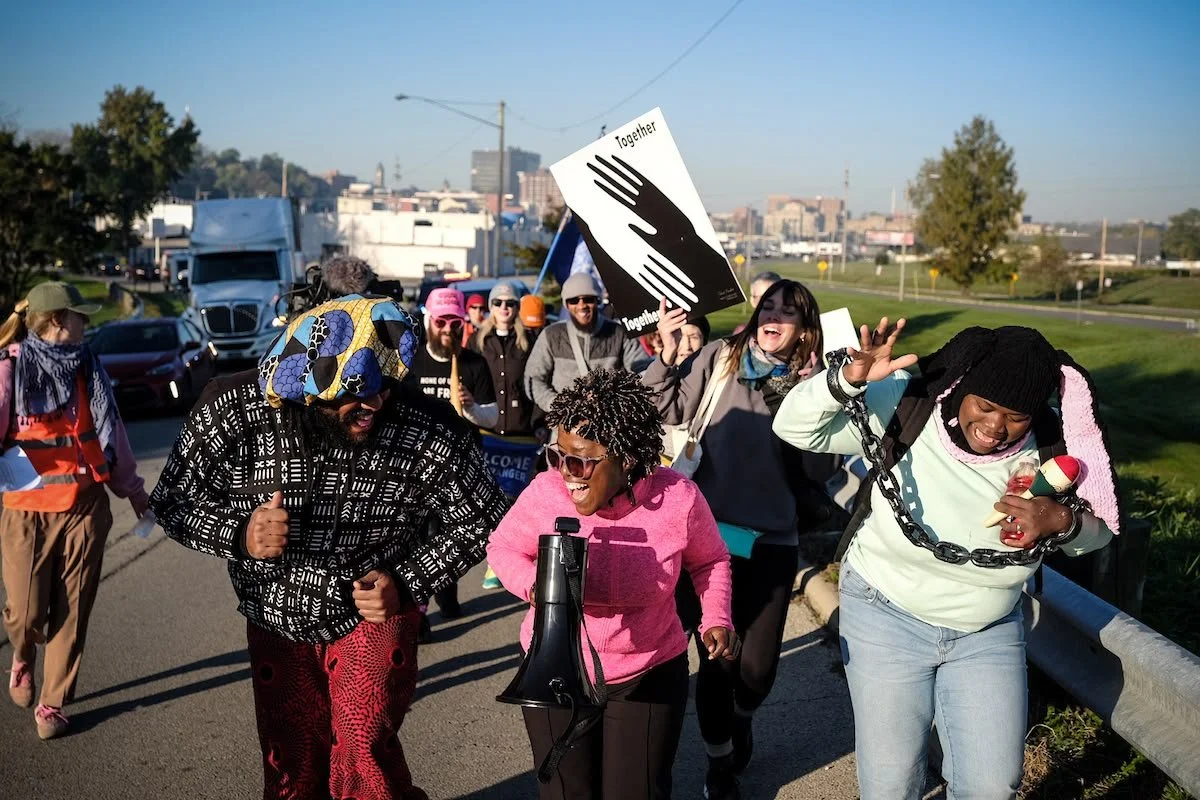
Photograph by Steve Pavey
Rev. Dr. Michael Woolf
One of my favorite poems that I have been turning to time and time again over the past few years is Warsan Shire’s “What They Did Yesterday Afternoon.” In it, the narrator talks about opening an atlas and asking, “where does it hurt?” In response, the map says, “everywhere/ everywhere/ everywhere.” There is pain everywhere, and it is hard to know where to put one’s attention.
That’s why when a coalition of Haitian pastors in Springfield, Ohio put out the call to make a pilgrimage from Springfield to Columbus, I saw an opportunity to put my finger on the map of pain in this country. The Haitian community in Springfield and all over the United States has been under immense pressure. You might recall that the Haitian community in Springfield was the target of President Trump during the 2024 presidential election in which he claimed, “In Springfield, they are eating the dogs. The people that came in, they are eating the cats. They’re eating – they are eating the pets of the people that live there.”
On July 27, 2026, the U.S. government ended Temporary Protected Status (TPS) for 350,000 Haitians living in the United States. The removal of TPS has had an immediately devastating effect, since the removal of TPS means that many Haitians lost their right to work in the United States and now face deportation. TPS had allowed Haitians to remain in the United States after natural disasters and gang violence destabilized their country. Or at least that is the official narrative. Personally, I feel that generations of blockade and economic warfare against the island nation following the revolt of enslaved people must be reckoned with as well.
We make a better world by doing things together. Sometimes, it’s a long walk because people asked you to, other times that solidarity might look different. But I firmly believe that we will never make the world that God dreams for us if we do not put one foot in front of the other in pursuit of that world.
One of the things that I heard repeatedly during my time in Springfield was that Haitian community members were being placed in ankle monitors, a deeply resented and dehumanizing move. Several times, I heard community members say that they were not criminals and should not be treated as such with ankle monitors. Many also brought up the case of Pierre Damas Bel, a student at Wright State University who died by suicide. His parents say Bel felt “humiliated” by his ankle monitor and opened the door to bullying from his classmates. This is not just a political issue to be discussed; it has real world effects.
I was only able to be there for the first and longest leg of the walk to Columbus, but what I saw gave me profound hope for a better world. As we walked, people came out to shout support and jeer, to offer cups of water and granola bars, and to laugh. There was a mixture of response, but it was the camaraderie of people who decided to place their finger on the atlas of pain in our world in Springfield, Ohio that made me think that compassion is not dead.
We make a better world by doing things together. Sometimes, it’s taking a long walk because people asked you to, other times that solidarity might look different. But I firmly believe that we will never make the world that God dreams for us if we do not put one foot in front of the other in pursuit of that world. Sometimes, we might even change the world just a little bit, even though we know that success is not guaranteed.
On our walk’s Signal chat, someone posted that at a recent immigration check-in with a Haitian community member, they had their ankle monitor removed, and it was placed in a tall stack of these devices. That doesn’t mean that everyone is free of ankle monitors, and it doesn’t mean that the pilgrimage made it happen, but it does mean that some people are freer than they once were, and for me, that is everything.
Rev. Dr. Michael Woolf is senior minister, Lake Street Church of Evanston, Illinois. He currently serves as the co-associate regional minister with the American Baptist Churches Metro Chicago. His book, published in 2023 by T&T Clark, is titled “Sanctuary and Subjectivity: Thinking Theologically about Whiteness and Sanctuary Movements.” He is also the co-founder of Challenging Islamophobia Together Chicagoland, an initiative that brings together people of all faiths to counter Islamophobia from a religious perspective.
The views expressed are those of the author and not necessarily those of American Baptist Home Mission Societies.
Get early access to the newest stories from Christian Citizen writers, receive contextual stories which support Christian Citizen content from the world’s top publications and join a community sharing the latest in justice, mercy and faith.