
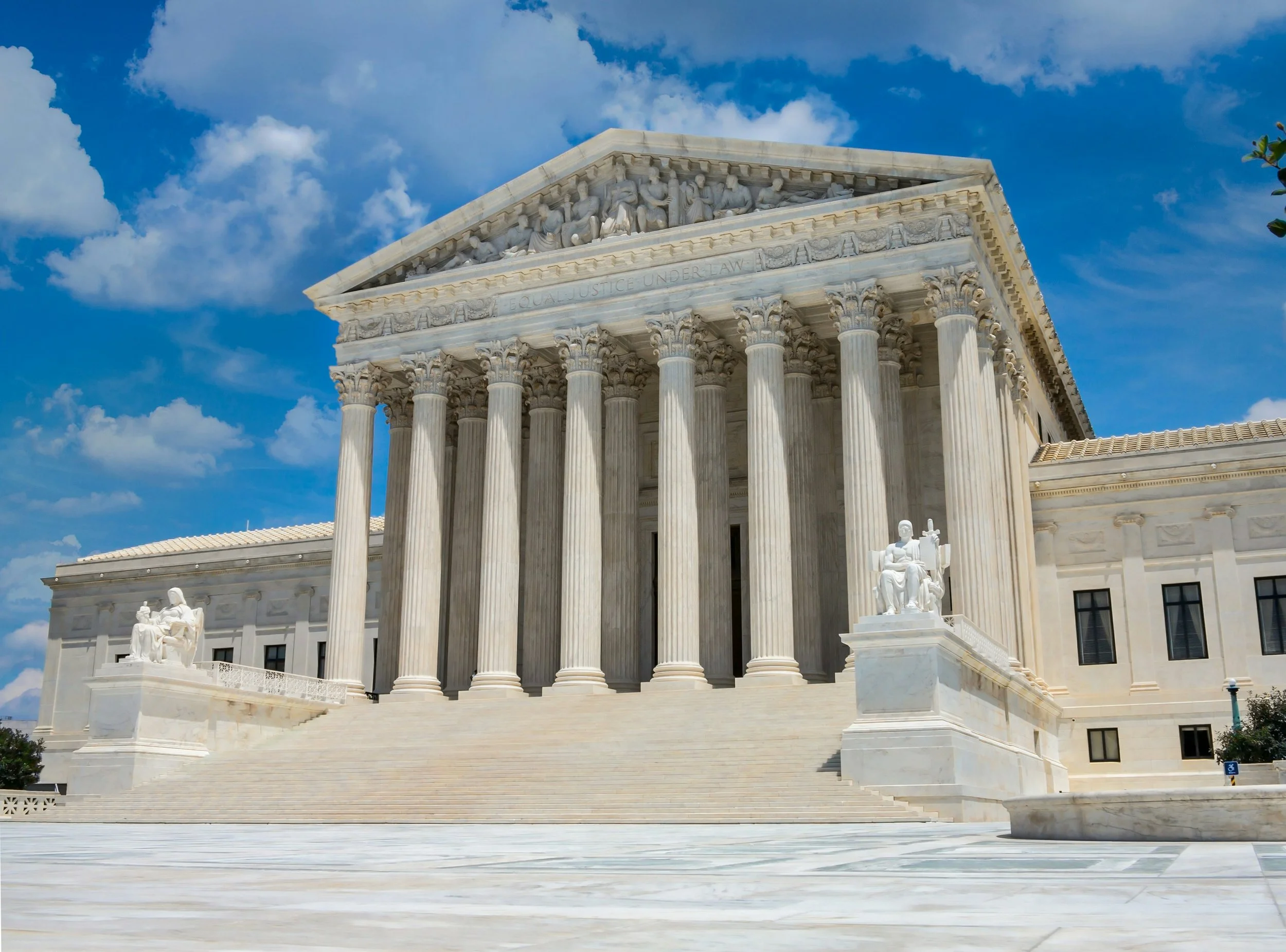
Photograph by Fine Photographics via Unsplash
Jason Collins
A years-long fight over a proposed grotto for the Virgin Mary in Park Hill, Kentucky, is nearing conclusion as the U.S. Supreme Court gets ready to set the precedent for religious exercise and land use for the rest of the country. On October 1, 2026, the court agreed to hear Missionaries of Saint John the Baptist, Inc. v. Frederic, with a date set for Wednesday, Jan. 20, 2027. The proposed grotto is more than just a disagreement over a religious structure and local zoning rules. It raises a broader constitutional question: how should courts balance religious liberty against legitimate community interests? Can a municipality really prevent a religious organization from building a place of worship on its own property?
The missionaries had hoped to build a grotto, a small shrine that resembles a cave, to house a statue of the Virgin Mary. The proposed grotto would be approximately 16 feet by 39 feet and would include “a shrine, a plaza, a walking path, and a retaining wall built into the hillside.” The residential property they plan to build on is owned by Missionaries of Saint John the Baptist, Inc., a nonprofit Roman Catholic organization, and is adjacent to the church. The members of the organization maintain that their faith requires the shrine to stand next to the church based on the apparition of the Virgin Mary at Lourdes, France, in 1858, who issued these instructions.
Attorney Sarah Benedict had told the Kentucky Supreme Court, “This is about an actual thing that happened in Catholicism, where there was a grotto, and the Virgin Mary appeared.” She added, “This is a religious exercise. This is not an ornamental thing; this is not some little piddly thing.”
In 2021, the Missionaries of St. John the Baptist Inc. received city approval to build the grotto. Mark Cooper, a resident and a former property owner of one of the parish’s buildings, told local news station WCPO, “Every Catholic church in Northern Kentucky has a grotto. They’re not asking anything out of the ordinary.”
But following the approval from the Park Hills Board of Adjustment, neighbors Joel and Elizabeth Frederic filed suit, arguing that the Board exceeded its authority under local ordinances and state law. They argued that the church is located in “a residential R-1EE zone where new religious buildings are permitted only if they face an arterial street.” The road where the church sits is considered a collector street. They also argued that the grotto would result in increased noise and traffic.
The Supreme Court’s decision impacts more than just this one organization’s grotto, it has implications for religious organizations across the country.
At the center of the dispute is the Religious Land Use and Institutionalized Persons Act (RLUIPA). This law, passed in 2000, is designed to protect religious institutions from discriminatory zoning practices. Under the legislation, the government can’t impose land-use regulations that burden religious exercise unless it can demonstrate a compelling governmental interest. The heart of the argument is what qualifies as a substantial burden. The Missionaries of Saint John the Baptist argue that the denial is interfering with their ability to express their faith on the property owned by them. Those opposing the grotto argue that local authorities must enforce legitimate zoning requirements and protect community interests.
“The city, recognizing the application of the federal law and my client’s religious liberty rights, granted the request,” Ryan Gardner, senior counsel at First Liberty, who is representing the missionaries, told WCPO. “And then it was an objecting neighbor who is now wielding the zoning ordinances as a sort of heckler’s veto … barring my client from engaging in this religious exercise of building this shrine to the Virgin Mary.”
There’s another layer of complexity with this case, and this involves the organization’s relationship with the Catholic Church. While they trace their roots to the Congregation of the Priests of Mercy, founded in 19th-century France, the current Missionaries of Saint John the Baptist were established in 2019 as a public association of the faithful under the authority of the Diocese of Covington. But, well into the land dispute in July 2024, Bishop John C. Iffert issued a decree suppressing the association, citing concerns about its members’ attitudes toward changes in the Roman Catholic liturgy. This decree was published in the January 2025 edition of the Diocese’s newspaper, “The Messenger.” But while the association of the Missionaries of St. John the Baptist is now outside the Catholic Church hierarchy, the suppression order has no effect on the Missionaries’ nonprofit entity, and it also means that neither the Catholic Church nor even the current Our Lady of Lourdes parish is party to the ongoing dispute.
Initially, the Kentucky Court of Appeals ruled in the nonprofit organization’s favor, but in November 2023, it said that the grotto is prohibited under the city’s zoning ordinance. A later ruling in 2025 found that the zoning restriction did not impose a substantial burden under RLUIPA. Kentucky Attorney General Russell Coleman had filed a petition requesting the U.S. Supreme Court to hear the case and consider how far RLUIPA’s protections extend when religious exercise conflicts with local land-use regulations.
The Supreme Court’s decision impacts more than just this one organization’s grotto, it has implications for religious organizations across the country. “If the Supreme Court takes up this case and issues a definitive interpretation of what this law means, it applies to every single zoning ordinance in this country,” Gardner explains. A ruling in favor could potentially strengthen protections under RLUIPA, making it more difficult for the government to reject religious construction proposals. But the case does raise concerns about how far these protections should extend into local planning decisions. Municipalities have a responsibility to consider the interests of the community by considering traffic, neighborhood development, and consistent zoning enforcement. The outcome should be able to define a balance between protecting religious expression and preserving governments’ authority to regulate land use.
Jason Collins is a writer whose work has appeared in Observer, Academy of Management, Talk Death, Nonprofit Quarterly, and Poynter, among other publications.
The views expressed are those of the author and not necessarily those of American Baptist Home Mission Societies.
Get early access to the newest stories from Christian Citizen writers, receive contextual stories which support Christian Citizen content from the world’s top publications and join a community sharing the latest in justice, mercy and faith.