
Standing on ground soaked in blood: A Holocaust remembrance
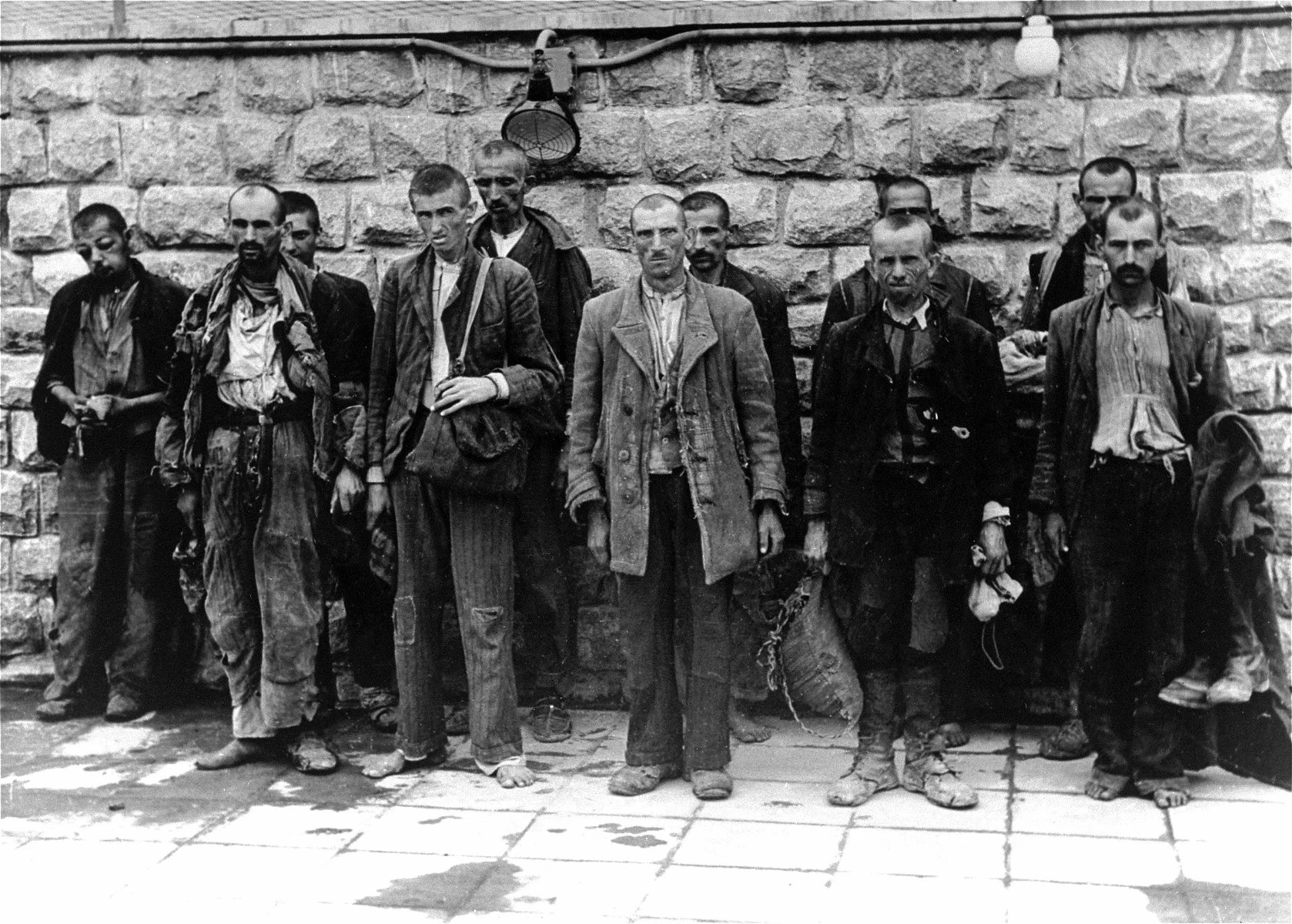
New arrivals at Mauthausen concentration camp, 1943-44. Photo credit: United States Holocaust Memorial Museum, courtesy of National Archives and Records Administration, College Park. Public domain.
Dr. Marvin A. McMickle
In May of 1995, I walked through the gates of the Mauthausen Concentration Camp in Austria. I was asked by a Holocaust survivor named Andrew Sternberg to accompany him as he returned with hundreds of other survivors to commemorate their liberation by the U.S. Army from that Nazi-controlled facility fifty years earlier in May 1945. In fact, one of the soldiers who participated in liberating that camp also accompanied Mr. Sternberg back to that camp. His descriptions of what they encountered fifty years earlier were as chilling and horrifying as anything the human mind can comprehend.
Many of the most notorious concentration camps were located inside of Germany and in occupied Poland, but there were also numerous camps all over Austria. Germany annexed Austria in 1938 in an event that was called the Anschluss.From that time until the end of World War Two, Austria was fully engaged as part of the Nazi apparatus and its pursuit of what was called “the final solution” which was the desired extermination of all the Jews in Europe. Between 1939 and 1945, approximately six million Jews were gassed, shot, or worked to death in camps like Mauthausen. Once dead, their bodies were stuffed into massive ovens where their corpses were burned. I remember standing in front of one of those ovens that remained as a reminder of what had happened there. When asked to offer a prayer in memory of those who had died, I said “We are standing today on ground that is soaked in blood.”
While thousands of people were held and murdered inside the walls of Mauthausen, thousands more prisoners were held within its multiple subcamps. Mr. Sternberg spent time in two of those subcamps, Ebensee and Melk. Ebensee was a labor camp surrounded by the towering peaks of the Alpine mountain range. Standing inside the camp, I was struck by the beauty of the surroundings, the mountains, trees, and sky. Yet those mountains served as a natural prison compound from which there was no escape. Those held in that camp had zero chance of escape. Their fate was sealed when they entered Ebensee. That was where they would be worked to death with minimal food and water and with no medical care of any kind.
Andrew Sternberg weighed 136 pounds when he was deported from Hungary in 1944 and sent first to Mauthausen and then to Ebensee. He weighed 85 pounds on the day he was liberated from that camp. Like Mauthausen, Ebensee was essentially a slave labor camp where people worked with tools, and sometimes with their bare hands to dig in rock quarries and to dig out tunnels where German aircraft could be repaired without being seen by Allied bombers that began flying overhead as early as 1944. One of the most solemn moments of my visit was inside one of those tunnels where a chamber orchestra played portions of Mozart’s “Requiem Mass for the Dead.”
On the other hand, Melk was essentially a death camp. It was the place where prisoners were marched down the road, shot if they fell and could not continue, and then burned once they had died from starvation or from disease. It was reported that there were bodies waiting to be burned, but the German SS soldiers fled and left those remaining unburned bodies stacked up as the Allied forces began closing in on that location. As I recall, there was no gas chamber that had been preserved at Melk, but there were ovens with adjacent chimneys that carried the ashes of burned bodies into the atmosphere beyond. People lived along the roads where prisoners were forced to march, often with bare feet through snow-covered roads. They must have known that people were being sent into that camp, and that none were ever coming out. However, according to the soldier who accompanied us on that visit, no one living nearby claimed any knowledge of what was going on inside Melk. Then and now, that seems impossible to believe.
When asked to offer a prayer in memory of those who had died at Mauthausen concentration camp, I said, “We are standing today on ground that is soaked in blood.”
What was more troubling than the apparent silence of the street-level neighbors of Melk was what we saw when we visited a Roman Catholic monastery situated on a part of a mountain that had a clear view of the camp far below and of the towering chimneys that pumped out human ashes day after day. It was impossible for those who lived in that monastery not to know what was going on at the base of that mountain. The sight and smell of smoke and ash undoubtedly reached them. Here again, when questioned by the U.S. soldiers in 1945, the monks claimed no knowledge of what had been happening in that death camp while they were at prayer in their mountain retreat. It is safe to say that it was this absolute silence, rooted in fear of retaliation by the Nazis, that allowed the Holocaust to extract that devastating level of death and suffering.
How is it possible that human beings could treat one another the way in which the Nazis treated Jews, Roma people, LGBT people, Slavic people, Jehovah’s Witnesses, and other ethnic, political, religious, and sexual minorities? The key was a propaganda campaign that served to deny these groups any legitimate human status, and to described them as sub-human or undesirable. I think about those events in Austria in 1945 while considering what is happening in the United States today, where massive detention centers are being built all over the country to hold thousands of people — referred to by government officials as “illegals” — without trial or access to legal representation. Once you successfully dehumanize a group and create that opinion among a portion of a nation’s population, you are on your way to an authoritarian regime where life and death decisions are made by sycophantic Cabinet secretaries anxious to carry out an America First agenda rooted in white privilege and white supremacy that feels strangely in step with the view of Aryan supremacy that undergirded the Nazi regime from 1933-1945.
Dehumanizing an entire group of people is how the transatlantic slave trade was justified for 400 years. It was also how the Native Americans that lived in this country before any Europeans arrived were either exterminated by smallpox or killed as part of a government policy, forcibly relocated as with the Indian Removal Act of 1830, or robbed of their culture through church-run boarding schools in the U.S. and Canada where the goal was to “save” the children by killing the Indian within them.
We, too, are standing on ground soaked in blood today as a result of the killing of Renee Good and Alex Pretti by ICE agents in Minneapolis and the deaths and injuries of many other people experiencing or protesting the cruelty of the second Trump administration across the country.
Marvin McMickle is pastor emeritus at Antioch Baptist Church in Cleveland, Ohio, professor emeritus at Ashland Theological Seminary, OH, and retired president of Colgate Rochester Crozer Divinity School in Rochester, NY.
The views expressed are those of the author and not necessarily those of American Baptist Home Mission Societies.
Get early access to the newest stories from Christian Citizen writers, receive contextual stories which support Christian Citizen content from the world’s top publications and join a community sharing the latest in justice, mercy and faith.