
Small things like these
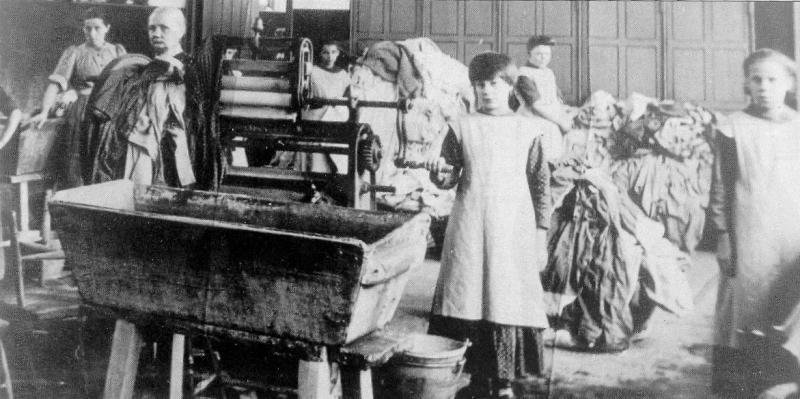
Unidentified Magdalene Laundry in Ireland, c. early 20th century. Public domain, Wikimedia Commons.
Nathan Perrin
If you were to ask me who the best possible literary writer living today is, I would answer without hesitation Claire Keegan. An Irish feminist, Keegan writes short stories and novellas centered around themes of religion, trauma, and the ordinariness of rural life. Her novella “Small Things Like These” is about the moral dilemma a blue-collar worker named Bill Furlong faces when he uncovers a Magdalene Laundry in his community.
The story faces Bill’s own dysfunctional childhood, the mourning of his loss of innocence in his early years, and the ways he views his daughters and wife. He wonders often what would happen if they were placed in Magdalene laundries and how he would want people to react. That lingering question haunts him in his day-to-day life.
The thought that ultimately moves him to action is revealed in this quote: “[H]e found himself asking was there any point in being alive without helping one another? Was it possible to carry on along through all the years, the decades, through an entire life, without once being brave enough to go against what was there and yet call yourself a Christian, and face yourself in the mirror?”[1] His faith acts in spite of church corruption, and he views faithfulness as the most humane response possible.
Very few books move me to tears. I’m notoriously known for reading edgy, transgressive fiction that challenges common sensibilities. Keegan’s novella, however, came into my life shortly after the Gaza genocide began. What the state of Israel was doing was obviously infuriating in itself, but what disturbed me the most was the inaction and apathy I saw among my Christian colleagues. Death and suffering no longer seemed to matter if they happened in Palestine.
In Illinois, there is a hundred-mile-long trail called the Prairie Path that runs by my house. I walk it frequently whenever I need to clear my head. One night in November on that path, I lifted to God my frustrations and anger at the silence of my Christian colleagues. I couldn’t believe how angry I was. That passage about the meaning of Christianity in the face of tremendous evil came to mind.
The acts of heroic intervention, even small, point us towards a world that God is actively resurrecting. We all have the chance to work toward the redemption of all things in real time.
One of the reasons I left the evangelical world was its deep suspicion of literature and the power of storytelling. I remembered frequent conversations in which people bragged about only reading the Bible. Reading fiction seemed to be like a waste of time to many folks. Even in progressive circles, I’ve encountered theology lovers viewing fiction as a waste of time or a frivolity. When I realized a part of my calling was to write fiction, I knew I could not tell the stories I wanted to tell while still being bound by evangelicalism.
And were it not for Claire Keegan’s “Small Things Like These,” I would have never become an activist and been arrested for my convictions two months later at the Cannon building on Capitol Hill. We live in an era of constant moral ambiguity, but we need courageous stories like this novella to remind us that evil often does have a plain face, and the real villains oftentimes are the well-intentioned neighbors who don’t want to get involved.
Like Bill Furlong in the story, we all come across injustices that beg for our attention and care. In this scandal-heavy world where our worst fears are coming to life — the Epstein files, the war in Iran, economic disasters, climate change — we all must have moments where we look in the mirror and realize who we are ultimately held accountable to. Keegan gently argues that a life focused on one’s own safety and good standing over the love of God and neighbor is not a life worth living. The acts of heroic intervention, even small, point us towards a world that God is actively resurrecting. We all have the chance to work toward the redemption of all things in real time.
Sometimes we get so caught up in the religiosity of Christianity that we forget what it means to live like Christ. Keegan’s novella shows us what this is like, not in the form of a clergy member or a politician — but in Bill Furlong’s empathy. He is not special in a way that makes any of us less special, except that when he sees injustice he wrestles with what to do. And that is ultimately what God all of us to do, whether that’s encountering unhoused folks or witnessing Christian silence about genocide. Life is not meant to be lived safely, and if we do live safely then perhaps it’s a sign that we don’t know the meaning of true love and sacrifice. There is a risk to doing the right thing. Both Keegan and the Gospel ask us to do it anyway.
Nathan Perrin (he/him/his) is a writer and Anabaptist pastor in Chicagoland. He holds an MA in Quaker Studies and is a doctoral student studying Christian Community Development at Northern Seminary. His doctorate work centers on creating a writing program for nonprofits and churches to use to help under-resourced communities process trauma. His work has been published in the Dillydoun Review, Bangalore Review, Collateral Journal, Esoterica Magazine, etc. His forthcoming novella Memories of Green Rivers will be released in 2026 by Running Wild Press. He is also a screenwriter. For more information, visit www.nathanperrinwriter.com
The views expressed are those of the author and not necessarily those of American Baptist Home Mission Societies.
[1] Keegan, Claire. Small Things Like These (Oprah's Book Club) (p. 66-67). Grove Atlantic. Kindle Edition.
Get early access to the newest stories from Christian Citizen writers, receive contextual stories which support Christian Citizen content from the world’s top publications and join a community sharing the latest in justice, mercy and faith.