
Israel calls it Independence Day, but for Palestinians it is the Nakba, or Catastrophe
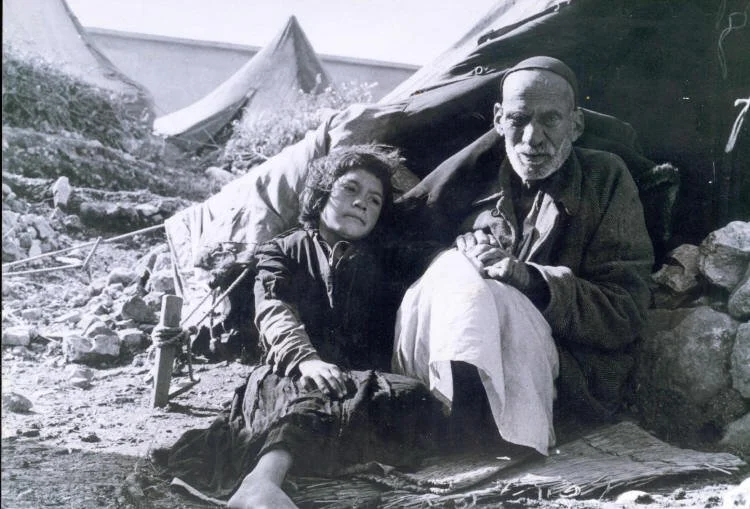
Photograph by Hanini via Wikimedia Commons. Free use under Creative Commons Deed - Attribution 3.0 Unported License.
Lesley Williams
Between 1947 and 1948 750,000 Palestinians from over 500 villages were ethnically cleansed from their homes in what is now Israel. This is an undeniable historic fact, yet like other human rights atrocities such as the slave trade and the Native American genocide, it is often glossed over. Yet any discussion of the current situation in Gaza is impossible without a clear-eyed look at how the Nakba, or “Catastrophe” came about.
First, it is best to dispense with several persistent myths, repeated so often that many accept them without question. Palestine was never “a land without a people for a people without a land.” Palestinians did not abandon their homes at the urging of other Arab nations. Nor did Palestinians stubbornly and unreasonably resist good faith offers of peaceful coexistence with Jews. Instead, the ethnic cleansing of Palestine was the final stage of a decades-long, deliberate campaign.
For over 400 years, the region of Palestine had been part of the Ottoman Empire, and was a multicultural society, with Christian, Jewish and Muslim residents. This does not mean it was universally peaceful, or that there was no ethnic conflict, but there was not the virulent antisemitism and racial supremacy found in Christian Europe. Palestine had often been a destination for those fleeing ethnic conflict elsewhere and had had a thriving Jewish community for hundreds of years.
Yet the First World War resulted in the last gasps of the great regional empires: the Austro-Hungarians as well as the Ottomans. In their place arose the powerful European countries France and Great Britain, which divided the remains of the Ottoman Empire. France took control of what is now Lebanon and Syria, while Britain established its mandate over Palestine and Transjordan. The breakup of the great empires was the catalyst for another regional innovation: the nation state. The notion that every ethnic group deserved its own separate land was extremely influential on a Hungarian Jewish lawyer and journalist named Theodor Herzl. In the late 1890s, observing the relentless antisemitism in Europe, Herzl concluded that the Jewish people would never be safe until they had their own country, where they were the majority and could control their own destiny.
Although Herzl and the early Zionists considered several possible locations for the Jewish state, Palestine, with its connection to Biblical history and tradition, was the first choice. It’s important to note that Herzl never planned for Jews to share any of these proposed homelands. Herzl was a colonialist, who explained the need to “spirit the penniless population across the border by procuring employment for it in the transit countries, while denying it employment in our own country.”[i] Herzl also propounded the myth of Palestine as “empty and deserted,” just waiting for Jews to come back, a “land without a people.” This colonial mindset, which was typical of Western Europe at the time, would form the basis for the Zionist conquest of Palestine.
Though Herzl was unable to gain political support for establishing a Jewish homeland, Jewish immigration to Palestine began to pick up towards the end of the 19th century and through the First World War. Then in 1917, Arthur Balfour, the British Foreign Secretary, issued the Balfour Declaration, stating that “His Majesty’s government view with favour the establishment in Palestine of a national home for the Jewish people, and will use their best endeavours to facilitate the achievement of this object.”
As the United States turns its attention towards Iran and away from Palestine, we must not forget the unspeakable horror of the Nakba, and we must no longer ignore the Palestinian demand for justice.
Balfour’s advocacy for a Jewish homeland was not rooted in a love for Jews; quite the opposite. A notorious racist and antisemite, Balfour had worked to keep Russian Jews out of Britain, and saw the Zionist movement as a way to “mitigate the age-long miseries created for Western civilization by the presence in its midst of a Body which it too long regarded as alien and even hostile, but which it was equally unable to expel or to absorb.”
However, the World Zionist Organization leapt at the offer, pushing for even greater Jewish immigration to Palestine. Between 1919 and 1923, 40,000 European Jews arrived; twice that many came between 1924 and 1929. Jewish organizations began purchasing large tracts of land from absentee Arab landlords, throwing Palestinian families off the land and into poverty. This rapid growth in Jewish settlement began to alarm the Arab residents, who soon realized that the goal was not coexistence but conquest. When the British mandate over Palestine was established, anti-Jewish riots broke out in 1920, followed in April 1935 by a general strike calling for a halt to Jewish immigration and to land sales. The strike developed into a major Arab uprising in 1936 against the British.
The three-year Great Revolt set the stage for the eventual expulsion of the Arab Palestinian majority. First, by 1936 many of the revolt’s leaders were killed or imprisoned. Second, while neighboring Arabs sympathized with Palestinians, Arab leaders feared that popular uprisings might spread to their own countries. These class struggles prevented the Arabs from forming a united front. Finally, the revolt hastened Britain’s desire to quit the region. Rather than work with local Arab leaders to pass the torch, they collaborated with Jewish paramilitaries, who would eventually morph into the Israeli Defense Forces. Several strategies used to quell Arab revolutionaries, such as home demolitions, would later be used against Palestinians during and after the Arab-Israeli war.
The stage was set. In 1947, as Britain prepared to abandon its mandate, the United Nations General Assembly recommended the partition of Palestine into an Arab Palestinian state and a Zionist-Jewish state. Although the Arab Palestinian population was over twice that of the Jewish population, and Jews were not a clear majority in any region, the partition plan allotted nearly 60% to the Jewish state, including most of the fertile coastal region.
Many claim that while Israel was willing to accept partition, the Arabs unreasonably did not, which led to them losing everything. However, looking at the numbers, what was unreasonable was expecting Palestinians to give up so much land to a recently arrived population half their size. More importantly, there is no indication that the Zionists planned to stick to their allotted share. David Ben-Gurion, Israel’s first Prime Minister, stated that “After the formation of a large army in the wake of the establishment of the state, we will abolish partition and expand to the whole of Palestine.”Chaim Weizmann, Israel’s first president, expected that “partition might be only a temporary arrangement for the next twenty to twenty-five years.”
Israel’s Plan Dalet, launched by the paramilitary Haganah in March 1948, made this abundantly clear. The goal was to expand the Jewish state far beyond the borders recommended by the partition plan, including major cities Lydda, Nazareth and Acre, that were earmarked for the Arab Palestinian state.
We must remember that the Nakba is not merely history, but an ever-present reality.
To accomplish this task, Jewish military forces began a campaign to expel residents and destroy Arab villages. The most infamous example is Deir Yassin, a Palestinian Arab village near Jerusalem. The village had no Arab soldiers stationed there and had signed a non-aggression pact with neighboring Jewish settlements. Yet on the night of April 9, 1948, Zionist forces attacked the village, killing dozens of Palestinian civilians. Survivor and eyewitness accounts describe horrific torture: numerous rapes and sexual mutilations, prisoners paraded through the village and then shot and buried in mass graves. Other village massacres and expulsions followed, but it was Deir Yassin that terrorized many Palestinians into fleeing. In her memoir, “In Search of Fatima,” Ghada Karmi recalls her family’s panic at the news, and how it was the final straw that convinced her parents to leave. “The worst of it was that the gangs who had carried out the killings boasted about what they had done and threatened publicly to do so again. They said it had been a major success in clearing the Arabs out of their towns and villages.”[ii] Menachem Begin, the head of the paramilitary Irgun, said with satisfaction that the massacre had “helped in the conquest of places as far away as Tiberias and Haifa.”[iii]
The completely understandable impulse to get one’s family out of harm’s way was quickly used as an excuse for dispossession. Israelis insisted that Palestinians had forfeited all claim to their property, with many insisting that Arab nations had encouraged their flight. Although the BBC, which monitored all Middle Eastern broadcasts throughout 1948, found no evidence of such a call, this canard has repeatedly been used to justify denying Palestinians the rights to their property.
In all at least 750,000 Palestinians left their homes, most forever. Once they were gone, Israeli soldiers secured their houses, farms and orchards, shooting any Palestinians who dared to return, and quickly moving European refugees in. Two of the first pieces of legislation initiated by the new Israeli government were the infamous Absentee Property Law, which systematically seized the property of all Palestinian refugees: homes, farms, land and even the contents of their bank accounts. All became the property of the state of Israel. The accompanying Land Acquisitions Law transferred the entire Palestinian economy to the Israeli state. In his book “Palestine Dispossessed: How the Law Organized the Dispossession of a People,” Najib Jabre estimates the current value of the stolen property at $155-$161 billion.
Villages were razed to the ground. Jews were settled in some areas formerly populated by Arabs, and other village sites were transformed into parks, often covered by pine trees or closed military zones. New Israeli settlements mushroomed over the ghosts of Palestinian villages, with Hebrew names replacing Arabic ones. Baysan became Beit Shean; Bir alSaba – Beersheva; Ayn Karim – Ein Karem. More laws were passed preventing Palestinians from returning home: the Citizenship Law and the Law of Return which guarantee Israeli citizenship for Jews but deny Palestinian refugees the right to residence or citizenship. Nearly 6 million Palestinian refugees registered with the UN live in Lebanon, Jordan, and around the world. Many residents of Gaza are the descendants of refugees who fled in 1948.
We must remember that the Nakba is not merely history, but an ever-present reality that has only escalated since October 7, 2023. In addition to the massive death and displacement in the Gaza Strip, more than 1,000 Palestinians have been killed by Israeli troops and settlers in the West Bank since October 2023, and over 13,000 displaced. Palestinian villages continue to be uprooted. Aggressive settlers boldly invade and take over Palestinian homes, harass children on their way to school, and uproot Palestinian olive trees. As the United States turns its attention towards Iran and away from Palestine, we must not forget the unspeakable horror of the Nakba, and we must no longer ignore the Palestinian demand for justice.
Lesley Williams is a librarian and equity consultant who organizes around anti-racism and Palestine with Jewish Voice for Peace, the Center for Jewish Nonviolence and Global Jews for Justice in Palestine. She has presented at conferences on equity and inclusion in schools and libraries, and on the intersections of Palestinian rights, Islamophobia, and anti-Black racism, and is a consultant and speaker for the PARCEO “Antisemitism From a Framework of Collective Liberation” curriculum. She reviews books on these topics for Booklist, and her writing has appeared in Truthout, Mondoweiss, and AWBC Magazine and in the books “Resisting Erasure: Libraries in Palestine,” “Palestine in Libraries,” and “The Anti-Defamation League: A Critical Reader.”
The views expressed are those of the author and not necessarily those of American Baptist Home Mission Societies.
[i] Morris, Benny. The Birth of the Palestinian Refugee Problem Revisited. Cambridge University Press, 2004, p. 41.
[ii] Karmi, Ghada. In Search of Fatima: A Palestinian Story. London: Verso Books, 2009, p. 125.
[iii] Ibid., 125-126.
Get early access to the newest stories from Christian Citizen writers, receive contextual stories which support Christian Citizen content from the world’s top publications and join a community sharing the latest in justice, mercy and faith.