
Dignity, safety, and hope across religious divides
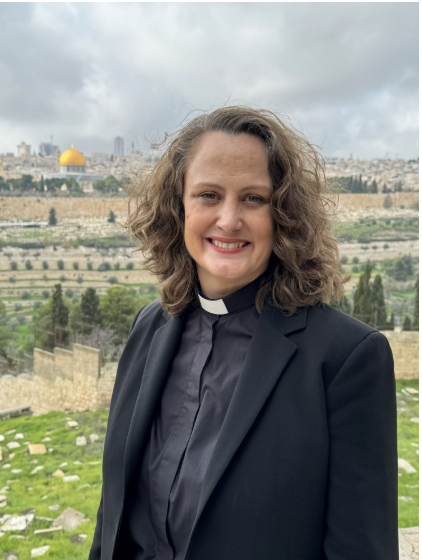
Photograph courtesy of Rev. Dr. Mae Elise Cannon
Rev. Dr. Mae Elise Cannon and Dr. Allison Wattenbarger
What could be significant about another letter from religious leaders calling for peace in the Middle East? At first glance, the letter signed by more than 140 global leaders, with representatives of more than 20 countries, organized by Churches for Middle East Peace (CMEP), might seem like just another in the litany of global religious responses seeking to address the atrocities being perpetuated in Gaza over the past two years and the horrors of the October 7, 2023 attacks. However, this particular global letter, signed by predominantly Christian bishops and executive-level leaders, also includes a smattering of internationally renowned and recognized Jewish and Muslim leaders. And this – in and of itself – is profound!
The multi-faith letter, released in November, includes Jewish, Christian, and Muslim leaders from various traditions across the globe, setting aside both political and theological differences, to jointly call political leaders to account for the famine and violence which continue to devastate Gaza. Since the October 10 implementation of the United States-brokered ceasefire, 20 remaining hostages in Gaza have been released, and airstrikes on Gaza have declined; however, Israeli forces have continued to bomb Gaza, kill Palestinians approaching the “Yellow Line” to which Israeli forces have withdrawn, and limit humanitarian aid to numbers far below those mandated in the ceasefire agreement.
Religious leaders signed this global call, which was sent as an open letter to President Trump and global leaders, calling for a swift end to the ongoing violence and destruction in Gaza and the West Bank, immediate and sufficient humanitarian aid and medical assistance in Gaza, adherence to international law and protection of human rights, and an end to the occupation of the West Bank. The letter acknowledges the trauma and suffering of all people in the Holy Land, including the fear and horrors suffered by Israelis on October 7 and in subsequent attacks, while calling attention and demanding a response to the more than 25 months of devastation, displacement, and havoc wreaked upon the more than two million people living in Gaza.
The letter represents the work of a growing coalition of religious leaders collaborating across religious traditions to address the ongoing devastation in Gaza and the broader Middle East. Their efforts build on Nostra Aetate, the 1965 declaration of the Catholic Church, which called for dialogue, respect, and collaboration among diverse faith traditions. Last month, the Vatican marked the sixtieth anniversary of Nostra Aetate by convening Jewish, Christian, and Muslim faith leaders in Rome to evaluate the current state of interfaith engagement. These discussions are moving beyond interreligious dialogue, with prominent and influential faith leaders working to cooperatively articulate and fortify the role of religious actors in peacemaking.
Conversations have begun to move beyond dialogue and to focus on the possibility of collective actions toward peace, asking the question about specifically what role religious actors can – and must – play in peacemaking and in discerning common commitments related to the effort to end violence in Gaza and between Israel and Hamas. As the Multi-Faith Global Letter communicates, Jewish, Christian, and Muslim traditions each affirm that all human beings are created in the image of God and every person is imbued with inherent dignity, equality, and worth. Each faith commands us to feed the hungry, shelter the displaced, care for the sick, and safeguard the vulnerable, especially the poorest and most in need.
Since October 7, 2023, multi-faith efforts around peace in Palestine and Israel have been more challenging than ever, with efforts across religious divides being viewed as normalization or a lack of loyalty to one’s own heritage or traditions.
These imperatives call each of us – Jews, Christians, and Muslims – to work towards flourishing for all human beings and a durable, just, and lasting peace in Israel and Palestine. The destruction of Gaza and the military occupation of Palestinian land stem from a struggle over access to the Holy Land. Yet the arbitration of that conflict has lain with political and government actors, rather than with the faith communities that treasure these sacred lands.
The letter bears the signatures of prominent rabbis, bishops, pastors, and imams who acknowledge that we, as faith leaders and religious communities, bear the responsibility and authority to advocate for and work towards peace, justice, and hope for all. Some of the Jewish voices, from Reform and Orthodox Jewish traditions include Rabbi David Saperstein, who served as the United States Ambassador-at-Large for International Religious Freedom under President Obama; Rabbi David Rosen, formerly with the American Jewish Committee; Rabbi Jill Jacobs of T’ruah: The Rabbinic Call for Human Rights; and Rabbi Michael Marmur, from Rabbis for Human Rights in Israel.
Christian signatories include diverse voices from Rob Peterson, president of the Evangelical Covenant Church of Canada; Jim Zogby of the Arab American Institute; to Jim Wallis, from the Center on Faith and Justice at Georgetown University; alongside Orthodox voices such as Archbishop Vicken Aykazian of the Armenian Church of America and Rev. Nicolas Kazarian of the Greek Orthodox Archdiocese of North America. Esteemed bishops are too numerous to name in their entirety, but include multiple communions of Catholics, Lutherans, Methodists, Episcopalians, and range from the Most Reverend Patrick A. Kelly, Archbishop Emeritus of the Roman Catholic Archdiocese of Liverpool; to Archbishop Thabo Makgoba, the Anglican Archbishop of Cape Town, South Africa; to the Most Reverend John C. Wester, Archbishop of the Catholic Archdiocese of Santa Fe, New Mexico; to Bishop Alexis Mitsuru Shirahama, ordained in the Society of Priests of Saint Sulpice and serving the Catholic Diocese of Hiroshima, Japan; to name a few.
Since October 7, 2023, multi-faith efforts around peace in Palestine and Israel have been more challenging than ever, with efforts across religious divides being viewed as normalization or a lack of loyalty to one’s own heritage or traditions. Thus, the Jewish, Christian, and Muslim signatories of this letter are courageous in their joint call to acknowledge the image of God in every human and to call for an end to all violence. A small number of Muslim leaders who signed the letter included individuals from groups like Religions for Peace, the International Qur’an Research Association (IQRA), and the Ansari Institute for Global Engagement with Religion at Notre Dame.
Might the mobilization of these leaders, and their clarion call, be an encouragement to us to allow, to quote from the open letter, “our shared Abrahamic heritage, not to be a source of division, but a foundation upon which to build a future where every child can live in dignity, safety, and hope. May the Holy One, Compassionate and Merciful, grant us wisdom, courage, and love to walk this path together.”
Rev. Dr. Mae Elise Cannon is the executive director of Churches for Middle East Peace (CMEP), ordained in the Reformed Church in America (RCA), and editor of A Land Full of God: Christian Perspectives of the Holy Land, in addition to being an author of several additional books.
Dr. Allison Wattenbarger has a Doctor of Theology in Hebrew Bible and the Old Testament from Duke Divinity School. She is an Ambassador Warren Clark Fellow (AWCF) at Churches for Middle East Peace (CMEP).
The views expressed are those of the author and not necessarily those of American Baptist Home Mission Societies.
Get early access to the newest stories from Christian Citizen writers, receive contextual stories which support Christian Citizen content from the world’s top publications and join a community sharing the latest in justice, mercy and faith.