
Christian Citizen practices: Meals
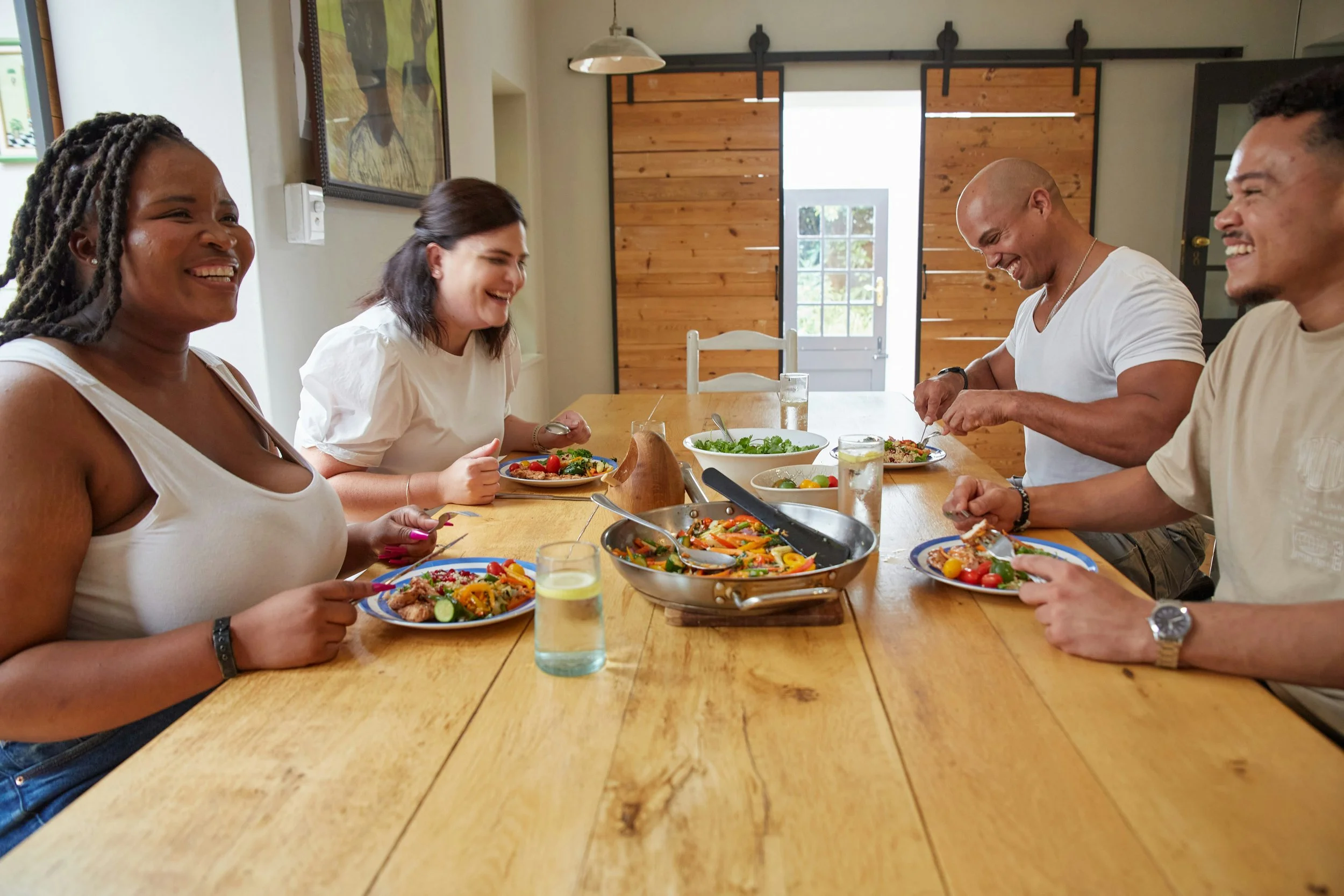
Photograph by Sweet Life via Unsplash
Rev. Clint Schnekloth
Author’s note: Spiritual Practices for Public Faith enhances The Christian Citizen’s commitment to connecting discipleship and citizenship by focusing both on what congregations are actually doing in their local contexts and how those practices sustain people spiritually for public engagement. Each piece will offer a short, accessible case study drawn from real ministry contexts, naming specific practices, what they aim to form in people, and what has or hasn’t worked in practice, while also attending to the inner life shaped by this work: burnout, resilience, anger, hope, and the habits that make long-term engagement possible.
When I walk into our church, I’m generally uncertain what it will smell like.
Sunday mornings, there’s often the waft of onions and garlic and peppers searing in a pan for the weekly community meal that Food Not Bombs is preparing to serve later that morning. I’m usually leading a study group conversation while this group of chefs, a mostly young-professionals friend group who practice food recovery and serve the hungry and homeless, prep their meal.
If I stay later into the day, the smells shift, primarily to fish, as the Marshallese church that rents part of our building serves its weekly post-worship meal, typically a to-go container filled with Marshallese delicacies: grilled chicken, several kinds of fish, rice, potato salad, breadfruit, chukuchuk, and sweet corn. The smell lingers throughout the church and well into Monday.
Every day there's also the possibility the church will smell like chicken nuggets warmed in the microwave, chili simmering on the stove, or ripe bananas on the counter because our residents — we shelter about a dozen people in the church — cook there for their regular meals.
By Monday and Tuesday, smaller meals are the norm. A gaming group likes to cook together before they play. Tuesday mornings bring food boxes from a local pantry for many of our residents. Tuesday is a sorting-food kind of day. Wednesday evenings we serve a meal for Open Doors, our LGBTQIA+ teen hangout space, often food purchased by parents. Yes, we eat a lot of chicken strips, tacos, and pizza. Throughout the week there are lighter gatherings, like our Monday morning donut crew, who almost always bring donuts and kolaches before we begin work.
Meal preparation and consumption at church is a whole ecosystem, and I would be remiss if I did not mention our Friendly Fridge, an outdoor refrigerator where we often place leftovers from community meals. If I sit outside and watch for an afternoon, someone will stop by every half hour or so, either looking for food or looking to donate it.
And of course there's the Little Free Pantry in our driveway, similar to the Friendly Fridge but for shelf-stable items. The Little Free Pantry movement was started more than a decade ago by our church administrator and has since spread around the world.
A few years ago, the city of Fayetteville approached us and asked whether they could place a food-waste collection station on our parking lot. We readily agreed. So not only are people recovering, preparing, sharing, and receiving food on our campus, they’re also bringing food scraps and returning them to the municipal composting system.
I wonder if it’s OK for things to sometimes just be intuitive. Like, we just kind of get it that Christians should feed people and one another. In this scenario the theology is entirely embedded in the practice itself.
I describe all this primarily to give a sense of where and how meals show up in our church. I have not yet mentioned the most “religious” meals of congregational life, like the meal we share in the Eucharist each week or our periodic congregational potlucks. These are the meals most people imagine when they think about food and church.
There is, of course, Lyle Lovett’s famous and tremendously catchy song “Church,” the refrain of which goes:
To the Lord let praises be
It’s time for dinner now let’s go eat
We’ve got some beans and some good cornbread
And I listened to what the preacher said
Now it’s to the Lord let praises be
It's time for dinner now let’s go eat
The last few times I’ve listened to this song it occurred to me that at least for the worshipping community Lovett sings about (and maybe experienced), worship itself was not focused on a meal but on the sermon. The meal was a communal but post-worship practice.
Admittedly, the way many of us do Eucharist does not satisfy as a practical meal. In our congregation we break up a loaf of gluten-free bread into small pieces and serve it together with small cups of juice, attempting to have one bread and one cup that does not exclude anyone from the meal because of dietary concerns.
But we do not serve enough to make a meal. A spiritual meal yes, a meal that provides the calories and nutrients needed for lunch, not so much. So even in our ostensibly “word and meal” worship if there were a grill going and some cornbread in the oven Sunday morning (and there often is) the meal prepared outside of worship could make a stomach growl.
Here’s what we provide beyond the Eucharist during our Sunday worship: there’s always coffee. And then our coffee team likes to prepare some popular snacks that get snatched up… peanut butter balls, snickerdoodles, small plates of cheese or fruit, sometimes lemonade. All of this appears on the visitors stand through the hospitality of those preparing the coffee.
Our neighbors, the Marshallese, whose UCC worship takes place mid-afternoon Sundays, distribute Communion less frequently in their Sunday service, but what they always do, without exception, is serve a meal, a culturally rich meal with fish and taro and rice and a rather wide array of other specialties, all distributed in take-home containers in the hopes of addressing food insecurity in some households.
As you can see, what I’m doing here is mostly describing what we actually do, with a lot less reflection on how this all lands theologically. I am of course aware of and have read some really great books about hospitality and meals and theology. I remembering being at a small church conference a few years back at Wartburg Theological Seminary in Dubuque, Iowa (arguably part of the breadbasket of America). Norman Wirzba’s “Food and Faith: A Theology of Eating” had just come out, and it became an important part of our discussions. I remember it awakening me to the issue of fidelity and food in unique ways given so much of our food comes to us through the industrial food economy. Michael Pollan’s “Omnivore’s Dilemma,” released a few years earlier, had had a similar impact on my thinking, although his fidelity to the trajectory of a meal from farm or forest to table had a more secular color to it.
I think what I’m observing here is that although we recognize that shared food is profoundly spiritual, it is still a space in which there is a kind of bifurcation, maybe even a kind of gnosticism, where in practice although we recognize that food and eating are entirely central to our faith, we nevertheless “just eat” without really always knowing how precisely it’s spiritual, besides the fact it just is.
I wonder if it’s OK for things to sometimes just be intuitive. Like, we just kind of get it that Christians should feed people and one another. In this scenario the theology is entirely embedded in the practice itself. One can reflect on it, but it’s mostly just the urgency of eating itself and the way it keeps us alive.
I don’t think we or most Christian communities start from a theology of eating and then move intentionally into how to eat together. I think it’s more likely we start by just feeding each other. Through us starting from what we observed as the greatest need (food insecurity is a real issue in our region and state, some of the worst in the country) and living among communities of people who would far rather make a meal for someone than have another meeting or conduct another study, the theology became for the most part, “We will feed people, and one another.”
Rev. Clint Schnekloth is pastor of Good Shepherd Lutheran Church in Fayetteville, Arkansas, a progressive church in the South. He is the founder of Canopy NWA (a refugee resettlement agency) and Queer Camp, and is the author of “A Guidebook to Progressive Church.” He blogs as Lutheran Confessions at Substack.
The views expressed are those of the author and not necessarily those of American Baptist Home Mission Societies.
Get early access to the newest stories from Christian Citizen writers, receive contextual stories which support Christian Citizen content from the world’s top publications and join a community sharing the latest in justice, mercy and faith.