
Being the church to the world
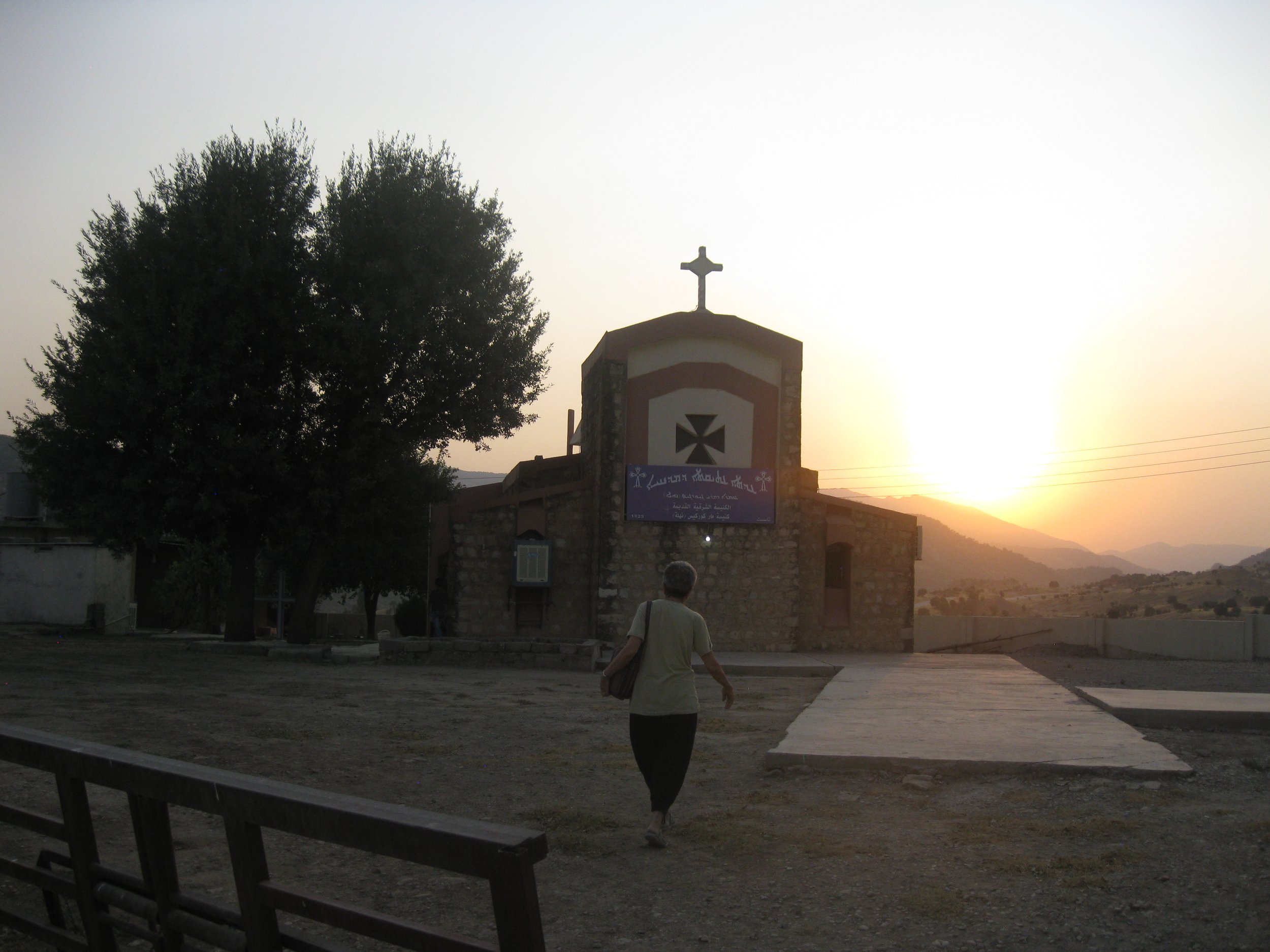
Keshkowa, Iraqi Kurdistan. Photograph by Nathan Perrin.
Nathan Perrin
It was September 2017 when my faith was changed forever in a small Assyrian village named Keshkowa in Iraqi Kurdistan. I was there with Community Peacemaker Teams. I officially decided to start deconstructing a lot of my evangelical culture and assumptions to experience what God had to teach me in the region.
Keshkowa was seated closely to a Kurdish Muslim village named Dupre. The region was filled with tension and excitement over the independence referendum to make Kurdistan their own nation-state, a proposal that both the United States and other governments swiftly denied - a global decision that led to instability and political violence, as well as a loss of 40% of Kurdish land.
I was exhausted, both spiritually and physically. I was naively trying to finish an Old Testament Hermeneutics class while on a delegation. But Keshkowa residents’ hospitality and warmth was good for my spirit. We sat around a long table eating lunch with them. We swam in their rivers. Laughter and jokes were shared.
One night, we attended a church service. I didn’t catch much of the liturgy, and the translator was barely audible. The only sentence I heard was, “Jesus wants us to be the church to the world.”
Keshkowa was a village that experienced persecution. During Saddam Hussein’s regime, their church was destroyed seven times. One of these times, soldiers took the cross off the building and used it as target practice. Each time, Keshkowa chose to rebuild.
Turkish bombardments were also a problem in this village. Dupre and Keshkowa both worked together in a beautiful interfaith friendship by allowing each other access to the other’s homes when bombardments began. Assyrian culture is traumatized to their core because of the genocide they experienced during World War I called Sayfo. Kurdish militias participated in the campaigns to drive and exterminate Assyrians from the region.
This cultural and historical trauma is still present, which made Keshkowa’s testimony all the more compelling and powerful. This village’s testimony forever changed the trajectory of my own faith, forcing me to reexamine what it meant to be Christian. The theology I had at the time wasn’t sufficiently answering what good it was to hold onto hope and to work for good as the political violence unraveled in Iraqi Kurdistan.
The testimony of an Assyrian community in Iraqi Kurdistan forever changed the trajectory of my own faith, forcing me to reexamine what it meant to be Christian.
Looking back, I’m glad my journey unfolded the way it did because opportunities opened up for me to serve marginalized groups without having to justify my ministry constantly. I absolutely love Jesus and the Bible, and some people from my past are surprised to find out I still hold to a literal resurrection and all the bells and whistles of orthodoxy. We unfortunately live in a world where many parts of the church consider social justice an outright rejection of these teachings.
As God often does in my life, he threw a book my way right after I came back the first time - Jürgen Moltmann’s“Theology of Hope.” After reading Moltmann’s ideas, I realized that part of my calling was to participate in God’s ongoing resurrection of the world through justice work and peacemaking.
A few years after my first trip to Iraqi Kurdistan, I moved to Chicagoland and decided to connect to the local Assyrian community. I attended a Syriac Orthodox church two miles from where I lived. As I worshiped and ate with them, I talked to a priest there. I told him about my experience.
“Keshkowa?” he smiled in between cigarette puffs. “Ah, yes. I know them well.”
A year after meeting, I started writing for an Assyrian media company dedicated to preserving their culture. It was a childhood dream of mine to become a screenwriter, and doing justice work, oddly enough, got me there. I continue to be blessed by those friendships, with a Syriac Orthodox deacon attending my own ordination as a Mennonite pastor.
Eight years later, when I returned to the region, I was sad to find out through the team on the ground that the Keshkowa community in Iraqi Kurdistan was forced out of their village by Turkish government in the name of “fighting terrorism.” However, the faith that inspired their radical inclusivity stays with me.
Whenever I help write about Assyrian culture, or whenever I visit with the Community Peacemaker Teams in Iraqi Kurdistan, I’m reminded of Keshkowa’s powerful ministry. That’s my own small way of continuing the message that Jesus wants us to be the church to the world.
Nathan Perrin (he/him/his) is a writer and Anabaptist pastor in Chicagoland. He holds an MA in Quaker Studies and is a doctoral student studying Christian Community Development at Northern Seminary. His doctorate work centers on creating a writing program for nonprofits and churches to use to help under-resourced communities process trauma. His work has been published in the Dillydoun Review, Bangalore Review, Collateral Journal, Esoterica Magazine, etc. His forthcoming novella Memories of Green Rivers will be released in winter 2026 by Running Wild Press. He is also a screenwriter. For more information, visit www.nathanperrinwriter.com
The views expressed are those of the author and not necessarily those of American Baptist Home Mission Societies.
Get early access to the newest stories from Christian Citizen writers, receive contextual stories which support Christian Citizen content from the world’s top publications and join a community sharing the latest in justice, mercy and faith.