
Advent peace across the walls
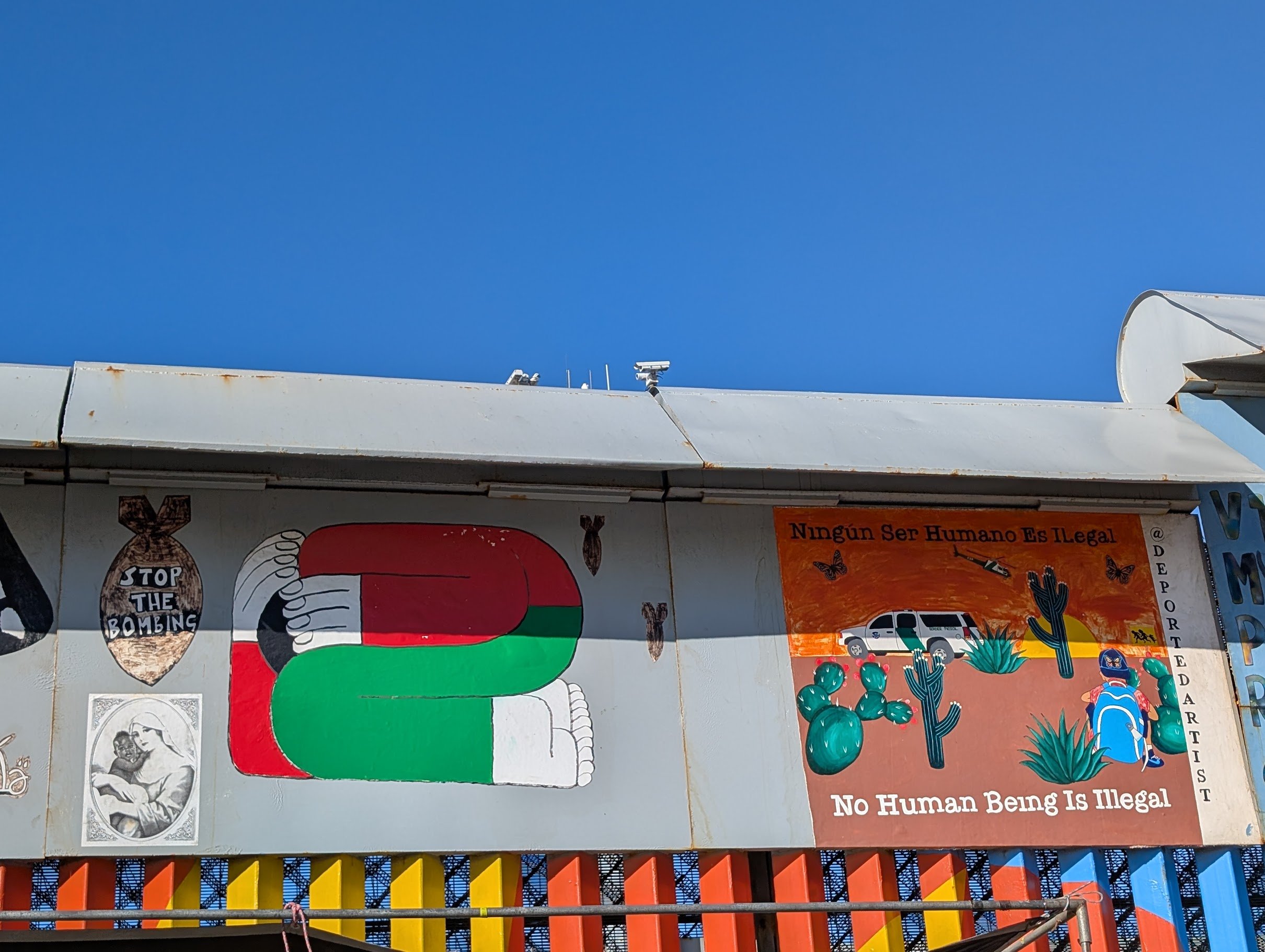
Murals at the U.S.-Mexico border wall. Photograph by Mindi Welton-Mitchell
Rev. Mindi Welton-Mitchell
I recently traveled to Tijuana, Mexico with three others from the American Baptist Churches of Wisconsin. I had the privilege of visiting back in March 2025 thanks to an invitation from the Border Church, and I wrote about that experience here.
The timing of our visit coincided with the protests at the Broadview ICE facility in Chicago, in which several clergy were arrested, including American Baptists. Many of the clergy who protested outside the facility asked to meet with detained migrants to offer prayer and communion. People who are in jail or in prison have a constitutional right to spiritual care, but they have been denied. The protestors also brought hygiene products, bread, and clean water to the facility to protest the dehumanizing nature and suffering of those imprisoned.
While my colleagues were arrested on Friday, November 14, that same weekend on Sunday, November 16, I preached at the Border Church in Tijuana, where members of our ABCWI team offered communion and prayer to those gathered, including those who have been deported. Once a gathering for migrants on both sides of the border, there are almost no migrants these days on the U.S. side due to fear of ICE and CBP. None are currently being detained in the open-air shelter where the Border Church meets, though the church is ready to offer prayer and spiritual support along with food and other physical necessities. However, on the Tijuana side, deported persons still gather. A meal is prepared by one of the local shelters, and clothing is offered to those who are in need. In a poignant moment, a deported U.S. Army veteran, wearing his Army jacket, came forward for communion. Other members of the community helped him walk from his seat to the table, where our team offered him the body and blood of Christ.
I reflected on the bitter irony that “in the land of the free because of the brave,” my clergy friends and colleagues were arrested in the United States for trying to offer spiritual and physical support for migrants, while in Tijuana we were able to freely share the grace and love of Jesus Christ with deported U.S. military veterans. People who served our country loyally and were honorably discharged, but then deported — sometimes for criminal activity, sometimes for being in the wrong place at the wrong time, all because we have not done enough to support our U.S. military veterans in the aftermath of combat.
The Border Church meets along the border wall between Tijuana and San Diego in a place called Friendship Park. As I shared when I first visited in March 2025, the Tijuana side still has lovely gardens and park benches and a lighthouse. The U.S. side has been torn up, a second border wall added and a security tower. The wall on the Tijuana side is covered with decorative murals. One reads “REPATRIATE” with the names of all the U.S. deported veterans painted on each beam of the wall. Another mural reads “No Human is Illegal.” But the mural next to the “No Human is Illegal” caught my eye, which shows bombs dropping on a person, who has crouched and covered their face as we were taught in bomb raid drills in the U.S. as schoolchildren. The person is wearing the colors of the Palestinian flag.
We learned that the border wall between the U.S. and Mexico, built by the United States, was raised from 18 feet to 30 feet in most places in consultation with Israeli engineers who built the wall between Israel and the West Bank. Both walls are built with government propaganda of keeping people safe, but instead create a militarized zone and instill fear. We learned that the U.S. engineers raised the wall, in consultation with Israeli engineers from their statistics, because a person could survive a fall from 18 feet relatively unharmed, whereas a person is more likely to be injured from a 30-foot drop.
Peace does not come through force. Peace comes to us in the bread and the cup. Peace comes to us when we put our hands on the wall to confess our sins, of everything that has separated us from God and from one another.
When I visited Tecate, Mexico in 2015 on a church mission trip, I noticed the U.S. border patrol with their rifles at their shoulders, looking down from the hillside above the wall. In Tijuana, the security tower that rises above the walls instills the same fear. On the West Bank, security towers and snipers do the same job. The walls are built to intimidate and control, rather than keep anyone safe.
I found myself asking the question when I was in Tijuana: “What are we thinking? What are we doing? How is this helping anyone?” A Mexican pastor helped me to understand that most people in Mexico want immigration reform for the U.S. as well. They have witnessed girls and women trafficked across the border. They have experienced the influx of weapons from the U.S. to the drug cartels as they watched drugs cross the border for years. But what has happened in the U.S. is not immigration reform. Immigration reform has been sidelined for decades due to partisan politics. Pathways for asylum seekers and refugees have been cut off. Family reunification parole processes and temporary protected status have been terminated for multiple countries. What we need is immigration reform that provides pathways for immigrants to live and work and study in the U.S. What we need is to respect the basic human dignity and worth of every person. Because every person is made in God’s image.
The wall is an ugly scar on the world that we and our tax dollars have built. It is a tool of oppression and intimidation, just as the immigration raids in Chicago, Charlotte, and so many other places in the U.S. have been. It has stopped people from coming for now, but it has done nothing to help the people who are here, the people who are in need, the most vulnerable among us. The immigration raids have caused irreparable harm to our communities, just as the walls along the U.S. border and the Israel/Palestine border have done. But just like the murals that are seen on the wall of the West Bank, so the wall in Tijuana shows that people will not live in fear. They will cry out for justice. They will cry out for peace.
Peace does not come through force. Peace comes to us in the bread and the cup. Peace comes to us when we put our hands on the wall to confess our sins, of everything that has separated us from God and from one another. Peace comes to us when we offer dignity to every one of God’s children: food, water, hygiene. Peace comes to us when we honor and respect our U.S. military veterans who have suffered PTSD and moral injury and provide resources for rehabilitation and healing. Peace comes to us when we stop the dehumanizing detention and deportation of migrants and Palestinians. Peace comes to us when we see one another, without walls. For Christ came to erase the dividing walls. Christ came as one of us, born as vulnerable as any of us, and died as one of us. Christ’s own life and death are witnesses to us of God’s deep love for humanity. When we deny the humanity of another person, we deny Christ. We deny the image of God. Matthew 25:31-46 reminds us clearly of the call of Christ:
“ . . . for I was hungry and you gave me food, I was thirsty and you gave me something to drink, I was a stranger and you welcomed me, I was naked and you gave me clothing, I was sick and you took care of me, I was in prison and you visited me.’ Then the righteous will answer him, ‘Lord, when was it that we saw you hungry and gave you food or thirsty and gave you something to drink? And when was it that we saw you a stranger and welcomed you or naked and gave you clothing? And when was it that we saw you sick or in prison and visited you?’ And the king will answer them, ‘Truly I tell you, just as you did it to one of the least of these brothers and sisters of mine, you did it to me.’” (35-40).
This Advent, as we talk about peace, may we practice peace first and foremost by seeing the humanity in each person, remembering our Savior who was born under an oppressive regime, fled with his family as a refugee, and died for all of us as a prisoner of the state, but lives again, and gives us all the promise of new life now, and eternal life with God.
Rev. Mindi Welton-Mitchell is executive minister, American Baptist Churches of Wisconsin.
The views expressed are those of the author and not necessarily those of American Baptist Home Mission Societies.
Get early access to the newest stories from Christian Citizen writers, receive contextual stories which support Christian Citizen content from the world’s top publications and join a community sharing the latest in justice, mercy and faith.