
The American warrior cult
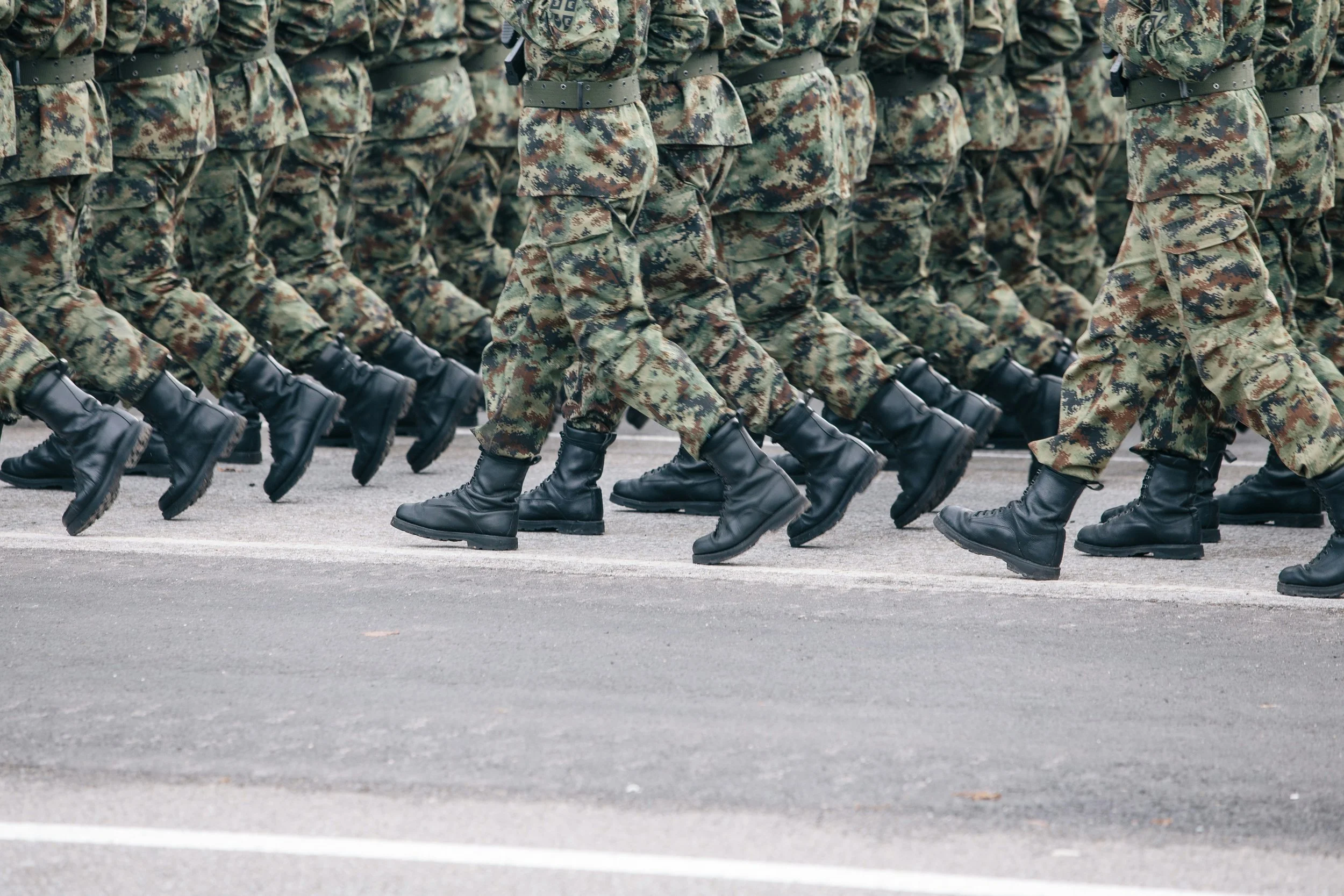
Photograph by Filip Andrejevic via Unsplash
Brian Gorman
In “East of Eden,” John Steinbeck wrestles with a nature vs. nurture debate through the lens of Cain and Abel. In the biblical story, God cautions Cain to check his jealousy: “If you do not do well, sin is lurking at the door; its desire is for you, but you must master it” (Genesis 4:7). Steinbeck’s character Lee, a Chinese immigrant who works as a household servant for one of the story’s protagonists, reflects on the phrase “you must,” timshel in Hebrew, translated as “thou shalt” in the King James. But Lee voices another interpretation of this word: “thou mayest.” It is the difference between viewing participation in evil as predetermined by events outside one’s control or as a lifelong struggle to choose goodness.
“East of Eden” is itself a retelling of the biblical story and timshel becomes the hinge for the entire plot. Are the characters doomed to inflict harm on others because of their nature, things that have happened to them, or the evil that “lurks” inside them, or are they able to choose a path of love? Steinbeck lands on the side of free will; humans are daily confronted with the choice to do evil or extend mercy, but it is always a choice, not a predetermined inevitability.
This story has been on my mind recently as videos surfaced of ICE agents killing protestors, threatening and accosting bystanders, detaining children, separating families, and many more disturbing images. I wonder about how people get to the point where they are willing to partake in such actions. Are they like Steinbeck’s character Cal Trask, lonely and desperate for validation? Have they accepted the narrative that they are beyond hope and destined to carry a legacy of evil, like Cathy, Cal’s mother?
Or is there another narrative at work, even more insidious because it masquerades as heroism? That is the narrative I would call the “warrior cult.” Americans, including American Christians, love a warrior figure. Members of the military and law enforcement are held in nearly unimpeachable estimation by many in American society. Military veterans are honored at nearly every professional sporting event, given better loan rates, better airline seats, discounts, and sometimes even better parking spaces. Americans cling to myths of bravery of those who die in war as paying for our freedoms with their lives. The warrior cult gives blanket cover for those who commit violence on our collective behalf, so much so that no politician would ever be elected to office if they disparaged the military generally or those who serve in it. This is true even when the cause being fought for is morally dubious or downright terrible.
The myths surrounding the warrior cult are draped in religious — often biblical — language. Religious language adds an additional layer of cover for those who commit violence on behalf of their country or in the name of protecting their communities.
Take, for example, the recent abduction of Venezuela’s authoritarian president Nicolás Maduro by U.S. Special Forces. While many people questioned the legality of the operation, no politician on either side of the aisle made any criticism of the officers involved in it. All were praised as brave or courageous, their skill lauded as the most elite and lethal in the world. We are watching in real time as the U.S. military and Israel engage in an unprovoked war in Iran and have already killed more than 1200 people, including at least 165 civilians at a school for girls bombed by a U.S. missile. Exhortations abound to valorize those during this war who “protect our freedoms.” We are allowed to criticize the politicians who give the orders to kill and destroy, but it is a heinous sin to criticize those who follow them.
The warrior cult comes with myths — of courage and deeds of bravery; rituals — holidays, flyovers, marches; and costumes — fatigues, T-shirts, flags. Ever since September 11, 2001, the warrior cult has been extended to include the police. Border patrol and ICE are also now included in the noble work of “defending” Americans from such fearsome enemies as construction workers, care providers, and house cleaners. When members of law enforcement are accused of abusing their position, they are given the benefit of the doubt over and against accusers because membership in the warrior cult comes with presumed moral superiority. The names of ICE officers involved in the killing of Renee Good and Alex Pretti were withheld by DHS precisely because individuals who join the warrior cult are given the protection of anonymity. We are meant to trust that they are constrained by just laws and orders. The warrior cult is very attractive for many young people looking for purpose in their lives.
This is deeply problematic for Christians, particularly when the myths surrounding the warrior cult are draped in religious — often biblical — language. Religious language adds an additional layer of cover for those who commit violence on behalf of their country or in the name of protecting their communities. Yet for the earliest Christians in some communities, renouncing military service was a prerequisite for baptism. These Christians understood that the Empire’s aims were fundamentally at odds with the self-giving love of Jesus and his command to love our enemies. What the Empire decides is permissible or necessary is less important than what the Gospel requires of those who follow the Crucified One. The Pax Romana is never the Pax Christi.
But for those who do choose to join the military or law enforcement, the church has a moral obligation to remind them that they are not bound by circumstance nor human order to participate in actions that kill, even when those actions are lawful. Like the suffering of Cathy and Cal in “East of Eden,” those who join the violent arm of the American Empire may feel trapped by oaths of loyalty, predestined to participate in whatever missions are assigned to them. The church must help liberate people from the warrior cult mythology.
Particularly as authoritarianism is on the rise, we must find a way to stir the conscience of those who participate in these inhumane and unjust actions. The resounding message from the church at this moment should be to those in law enforcement, particularly ICE, and those who serve in the military: Sin lurks at your door but thou mayest master it. Join the side of justice and mercy, where the risen Christ invites you with loving, forgiving arms. Timshel.
Brian Gorman is co-founder of The Hiding Place, an urban farm, community gathering space, and house of hospitality in the Catholic Worker tradition. He holds an MA in theology from the Ecumenical Institute of Theology. He homesteads, is a stay-at-home dad, and teaches piano lessons.
The views expressed are those of the author and not necessarily those of American Baptist Home Mission Societies.
Get early access to the newest stories from Christian Citizen writers, receive contextual stories which support Christian Citizen content from the world’s top publications and join a community sharing the latest in justice, mercy and faith.