
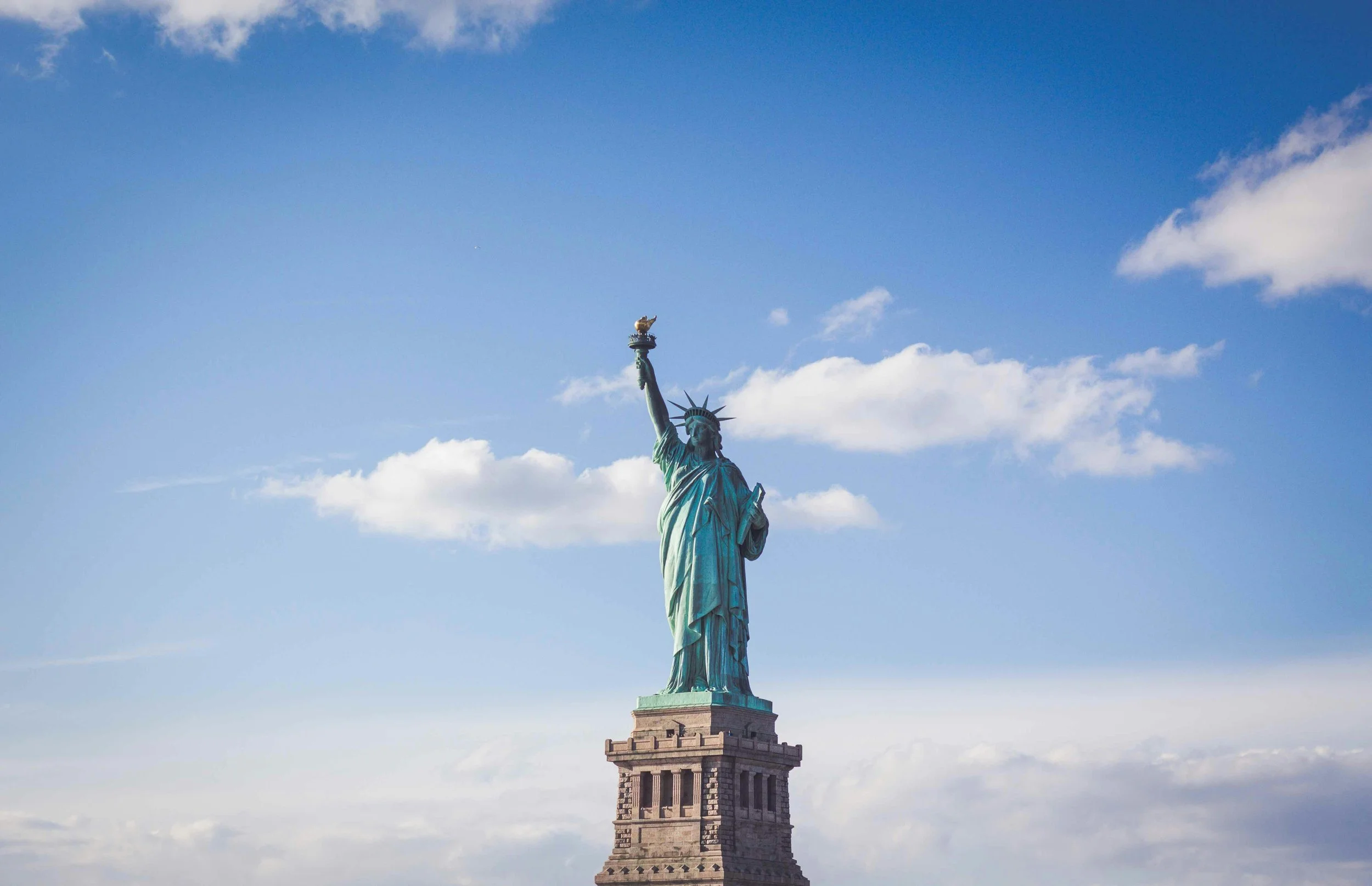
Photograph by Fernando Strabuli via Unsplash
Rev. Dr. Paul Bailey
At the Bicentennial in 1976, I was working at Valley Forge National Park behind a concession stand selling pewter plates. The Conestoga wagons had arrived after working their way across the country. President Ford landed in a helicopter to say a few celebratory words before heading to his next stop, praising Americans’ history of sacrifice and courage.
At this Semiquincentennial, those American values seem to be fading. Any desire for happiness and prosperity has become the pursuit of greed. Our international strength has been used to bully, instead of offering aid. Truth has been replaced by spin, or outright lies repeated often enough we don’t know what to believe. And is there such a thing as an American value that is Christian?
A recent poll by Gallup and With Honor asked Americans to choose which values (from a list of 12 options) they believed were shared by most Americans regardless of background or politics. While no single value was agreed upon by a majority of respondents, the top 3 included freedom, patriotism, and service, with freedom ranked the highest.
In 1941, President Franklin Roosevelt proclaimed that American uniqueness was expressed in four freedoms: freedom of speech, freedom of worship, freedom from want, and freedom from fear. But today we are increasingly aware of their disintegration. Freedoms that seemed “self-evident” can be stricken with the stroke of a pen. Freedom of speech and from fear can easily be strangled with a lawsuit, legal defense costs, and a warning about exercising those freedoms in the future. Before using our freedom of speech, we must check with our tribe’s censors and evaluate the risks potentially created by social media.
Patriotism, defined as “caring about your country and wanting it to live up to its ideals,” ranked second in the Gallup poll of shared American values. USA Today’s Susan Page noted that the poll also demonstrated that we cannot agree on those ideals across partisan lines, with especially wide gaps between Democrats and Republicans on the importance of patriotism as a shared American value.
Service ranked third in the poll. While we often claim to be a generous nation, across the street and around the world, we now send disaster relief primarily to states that identify with the political party in power, and U.S. humanitarian assistance has dropped to its lowest level in two decades.
Kindness was number four. We often see ourselves as a nation that welcomes the stranger, echoing the message embedded on the Statue of Liberty, but that invitation is now confused, as we build higher walls and arrest those whose only “crime” is an expired visa. A decade ago, I was asked to bring some words of encouragement to a Karen congregation in Syracuse, so I pointed out that everyone in America originally came from somewhere else and they were in good company.
Could I say that now?
I am most proud to be an American when wrongs are acknowledged, not covered up, and we take steps to make them right. That is, and should be, our most Christian American value. When we lose that, we lose all the others.
There were other values in the poll. Equality was in the middle of the list, the idea that we claim to be the land of opportunity, where everyone can achieve their dreams. Yet pursuit of happiness is increasingly reserved for those who are already happy. We once boasted about our democratic form of government, but now we discuss how to limit certain groups from voting, and Congress just yields to the executive branch. We undoubtedly will hear it declared that America is a Christian nation founded by faith-filled founding fathers, but today it would be impossible to even define which type of Christian we are talking about, let alone what type of Christian America.
In fact, some of our traditional American values have helped many over our 250 years, but the greatest American value may be the one that no one talks about. There is one American value that is both Christian and is a true strength.
It is repentance.
Humility was ranked the lowest in the poll of shared American values. It is when we confess our wrongs as a nation and are not unapologetic. It is when we recognize we can do better and are never great enough. Alexis de Tocqueville observed that the greatness of America lies not in being more enlightened than any other nation, but rather in Americans’ ability to repair our faults. Even in times when schools are told to only say good things about America’s past and museum displays are covered up if they remind us of ugly truths in our history, there are always people taking the risk of truth-telling, calling us to abandon foolish ways and to strive to find a better way. When we are wrong, we can say the words, not proudly, but with every effort to turn it around. And when we get better, we also know that we can do even more.
It is interesting that grace also is a Christian value. We are saved by it so that we are free to work towards what we pray every Sunday, “Thy kingdom come, Thy will be done, on earth as it is in heaven.” The Apostle Paul made it personal when he wrote, “Not that I have already obtained this or have already reached the goal; but I press on to make it my own, because Christ has made me his own.” (Philippians 3:12).
I am most proud to be an American when wrongs are acknowledged, not covered up, and we take steps to make them right. That is, and should be, our most Christian American value. When we lose that, we lose all the others.
Rev. Dr. Paul Bailey retired in 2021 from the Eastwood Baptist Church in Syracuse, NY. In addition to over 40 years of pastoral ministry, he was an adjunct instructor in Communications at Onondaga Community College for 15 years.
The views expressed are those of the author and not necessarily those of American Baptist Home Mission Societies.
Get early access to the newest stories from Christian Citizen writers, receive contextual stories which support Christian Citizen content from the world’s top publications and join a community sharing the latest in justice, mercy and faith.