
Pray + Art peace sculpture
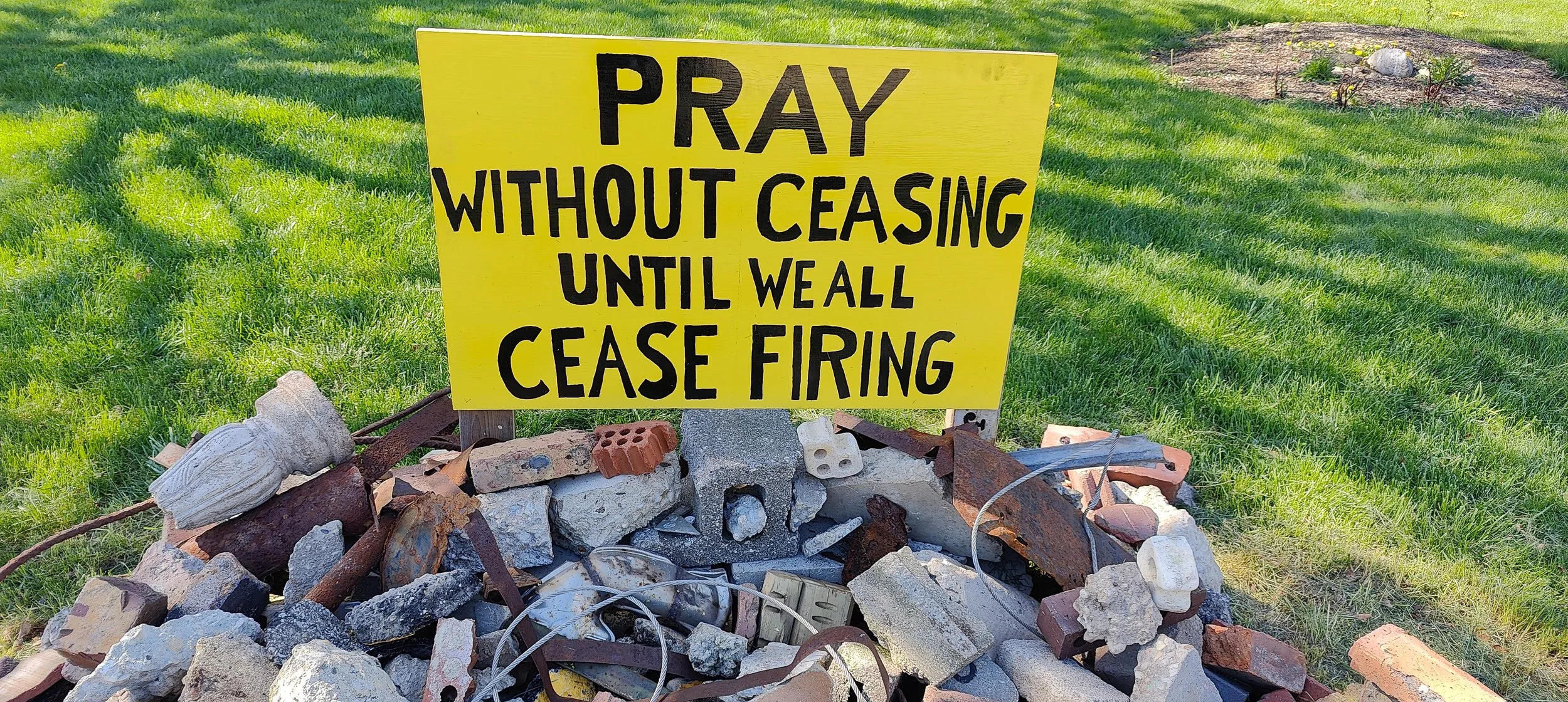
Photograph courtesy of BiCS (Ben C. Squires).
Benjamin C. Squires
On June 22, 2025, as word came that the United States had joined Israel’s attack on Iran and had bombed Iran’s nuclear facilities, the lyric was loud and clear in my head: “We can bomb the world to pieces, but we can’t bomb it into peace.” Michael Franti & Spearhead’s “Bomb the World” (I prefer the “Armageddon Version”) played on repeat in my mind.
But what to do with this antiphon of grief and lament, feeling as if “the world won’t listen” (an album title from The Smiths)? And the world certainly won’t listen if the words are only my internal soundtrack. How will they hear without a word-sharer?
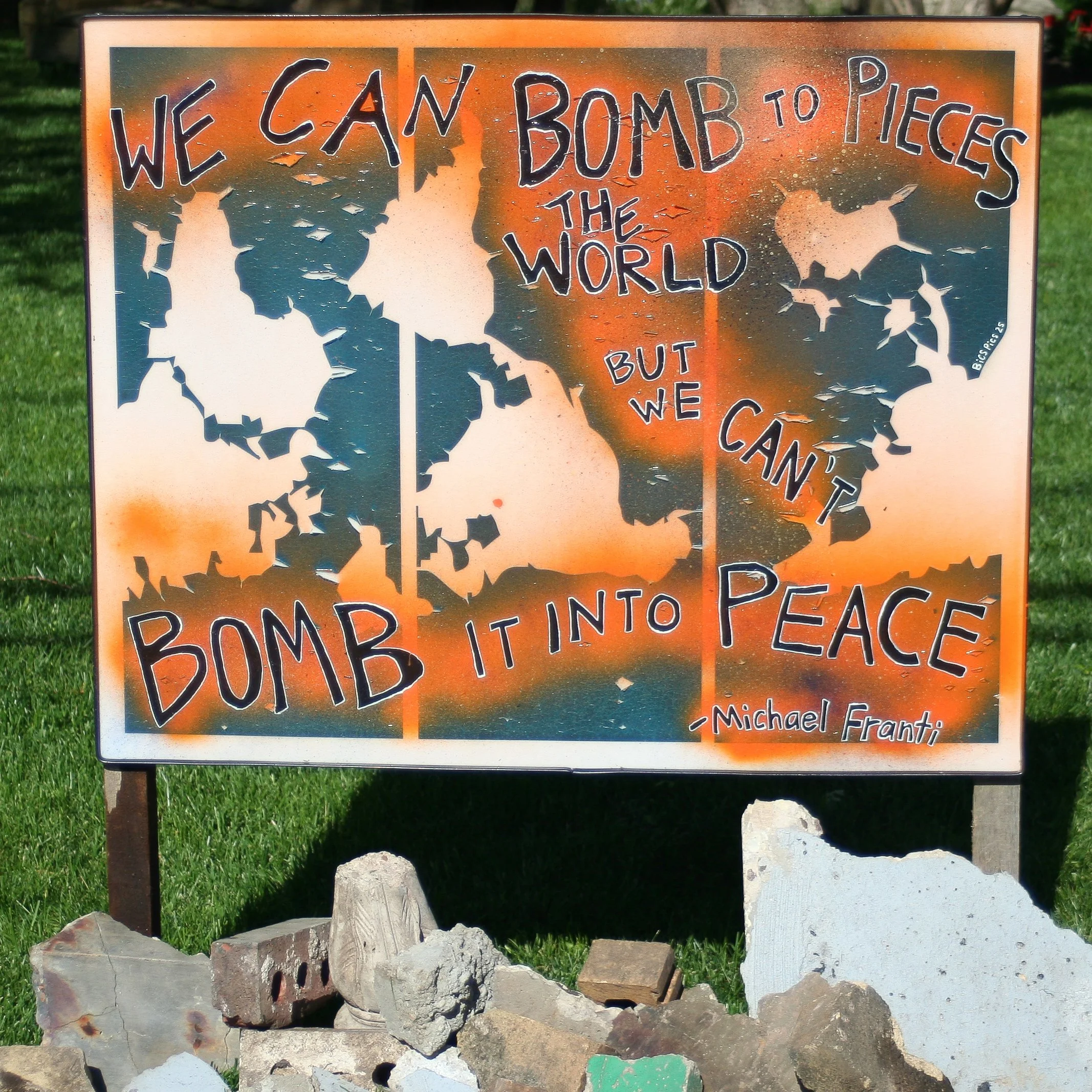
Yard art by BiCS (Benjamin C. Squires) inspired by Michael Franti’s “Bomb the World.” Photo courtesy of Benjamin C. Squires.
Sermon Art Becomes Yard Art
I have been processing words out loud as a preacher for over 25 years, but sometimes I wanted visuals to go with those sermons. Not “up on a projector screen” visuals, but tactile props to help illustrate the Scripture text I was attempting to proclaim. Key words written large enough for everyone in the sanctuary to read that I could assemble, hoist, swap around, or replace as I was preaching.
Lacking the funds to print slick posters on a regular basis, I found a cheaper alternative: scrap wood or foam insulation, and hand-painted words.
I did this for many years with many sermons. Then COVID-19 shut everything down. The spring of 2020 found us all mostly at home, nervous to be near people, but longing for connection. Noticing that a lot of people were regularly walking in my neighborhood, and inspired by stories on the news about how people were encouraging one another, I built my first piece of yard art: Scrappy. A roughly human form made from old fence boards and 2x4s with a hand-painted sign: “Stay safe.”
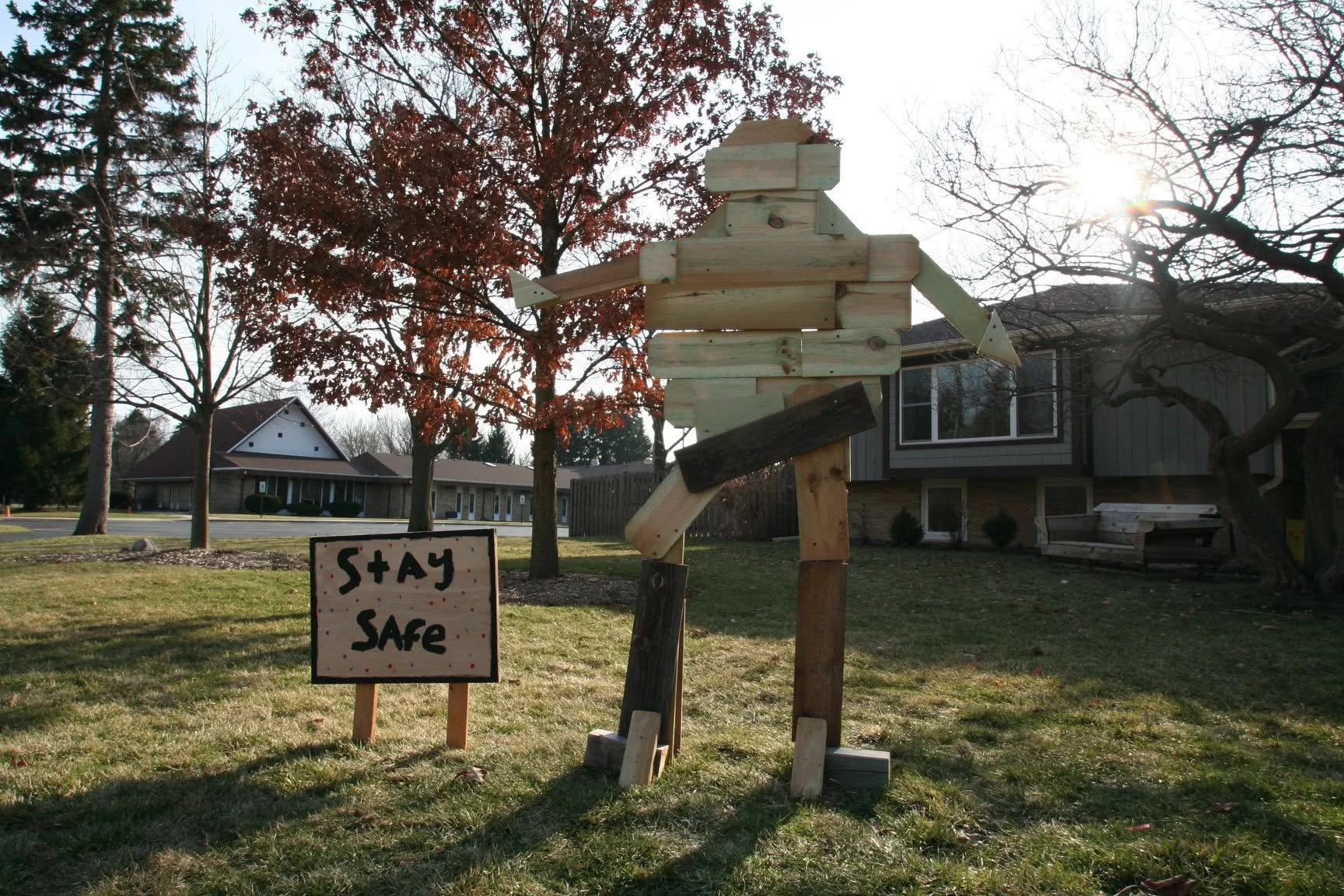
“Scrappy,” a yard sculpture built in 2020 by BiCS (Benjamin C. Squires). Photo courtesy of Benjamin C. Squires.
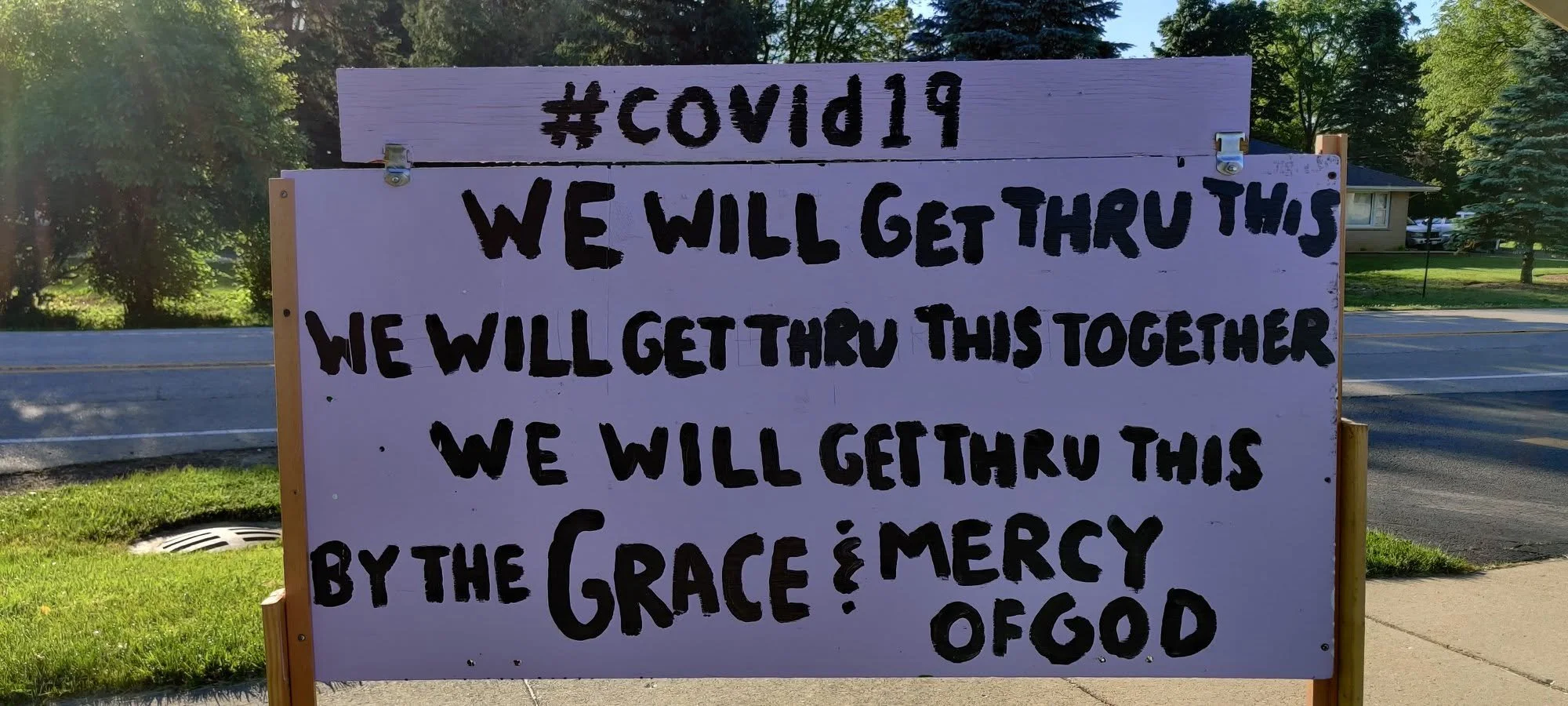
Scrappy led to other yard art, like the liturgy of sorts by Kentucky Governor Andy Beshear: “We will get through this. We will get through this together,” from his daily press conferences. Augmented with “We will get through this by the grace and mercy of God,” Beshear’s words became a hand-painted yard art liturgy installed next door at church.
Pray + Art
When I say that I make yard art, I should have mentioned that I live in the parsonage. Art then is an expression of my creativity, but I must also keep in the mind the pastoral nature of how I use art in the church-owned yard.
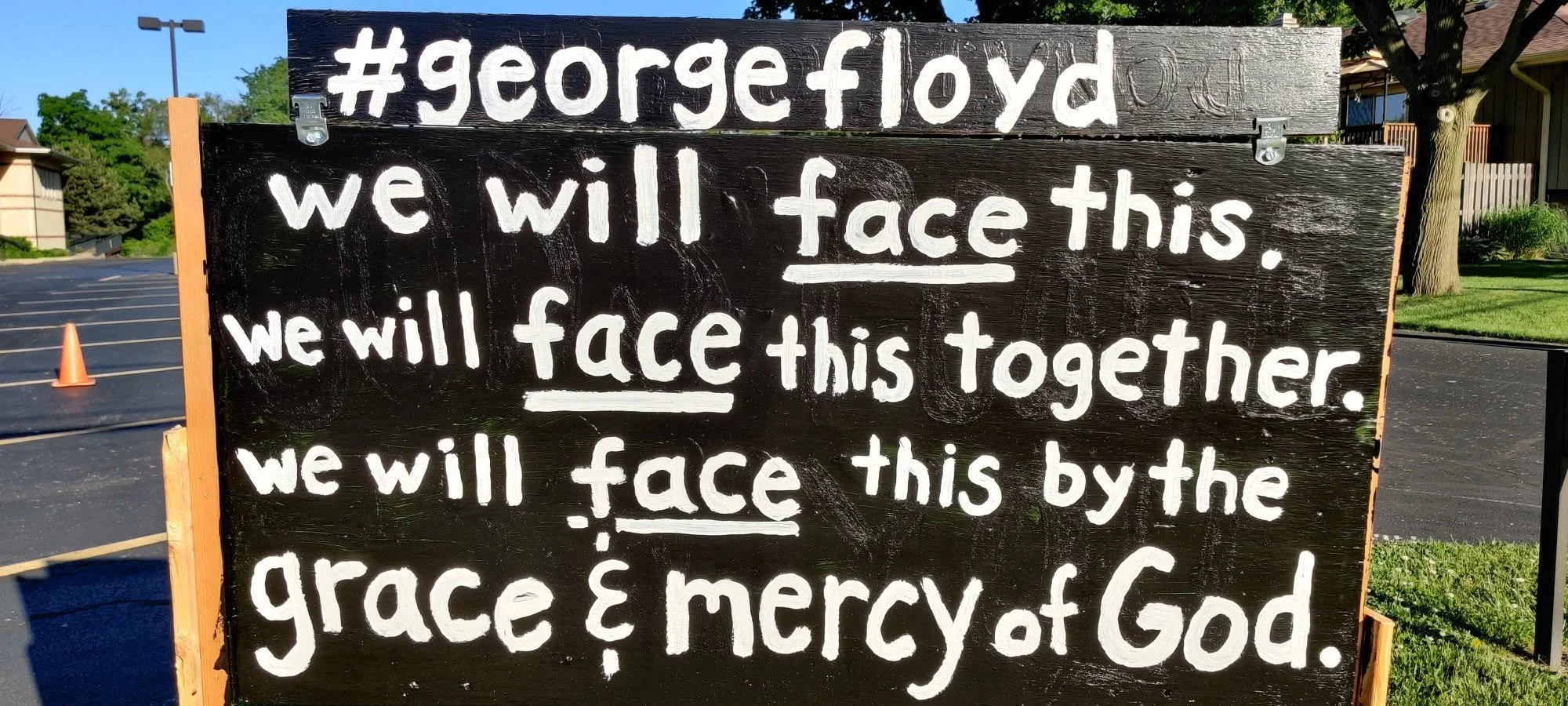
After George Floyd’s murder, the Beshear liturgy was adjusted: “We will face this by the grace and mercy of God,” with an added board at the top: “#georgefloyd.” We weren’t going to just “get through” the racial reckoning; we were going to face the sin of racism and its systemic injustices.
During vigils that summer, and wanting to combine prayer walks with art, I came up with the term: “Pray + Art” (“prayin’ art”). It is what I labeled what I was doing on street corners where I set up a prayerful presence with hand-painted signs, giving away hopeful photos, and talking to people, like the day in 2021 I was in downtown Waukegan while we all waited to hear whether they would convict George Floyd’s murderer.
Whatever Pray + Art signs I made for use out in the community, they ultimately came home and were installed in the yard for a while to continue the prayers, spread the message, and help the words get out of my head because I am a word-sharer.
“Bomb the World” sculpture
So it was that on June 22, 2025, I knew that the Michael Franti lyric needed to be painted and proclaimed. I also collect a lot of junk (trash) and odds and ends that I love using for making art.
Spray paint, paint pens, polyurethane, and some posts recovered from near railroad tracks, and I had my yard art decrying the attack on Iran. Given the lyric (“bomb into pieces”), I gathered up some of my old bricks and concrete pieces to lay at the sign’s feet.
Shortly after this, I praised God for hearing my Pray + Art as a ceasefire was declared. Once it seemed that peace would really hold, I put the sign and bricks into storage.
Peace sculpture
On February 28, 2026, the sculpture went back up as the United States went into full war against Iran. The sign and the rubble went in the yard again as a prayer.
Over the course of the first month of war, every day I went out into the community searching for more rubble to bring back to add, each piece another brick in this wall of prayer against the needless destruction and heedless plans for domination.
Because I hunt for junk to use in my art, I knew all the best places to look for discarded bricks, broken concrete, bridge spallings, and crumbled asphalt. The daily searching and placement of the rubble became prayer in movement and art. I invited people in the community to stop by with their own piece of rubble and their prayer for peace.
Peace sculpture by BiCS (Benjamin C. Squires). Photograph courtesy of Benjamin C. Squires.
When there was the possibility of a ceasefire agreement, I made a new sign: “Pray without ceasing until we all cease firing.”
However, as the ceasefire agreements come and go, or are established and broken, I keep adding rubble to the pile of a world bombed to pieces.
Palestine Peace
I have been pleading with God since October 7, 2023, for there to be peace for Palestine and Israel, for Gaza to be spared, and for the West Bank to be protected.
Though the Peace Sculpture is tied to the United States’ war against Iran, the sculpture also holds rubble as prayers for Palestine.
Hope remains, however dormant it may seem. Hope that Jesus will bring peace soon and very soon. Hope that Jesus will restore the people and places our nation has destroyed. Hope that one day Jesus will return to restore all people and all things in a New Creation that will not have piles of rubble pockmarking it.
Over three separate sessions, I walked the dimensions of Gaza, documenting this on social media to help people recognize just how small the area is and to pay attention to their suffering. My final leg was 12 miles, and so I carried a backpack, picking up a brick or piece of concrete each mile, that I then brought to the peace sculpture.
While listening to an online conference from the Bethlehem Institute for Peace & Justice, I loaded up my backpack twice with bricks along the shore of Lake Michigan, reminders of buildings demolished long ago. Wrestling with the weight through the July heat, my prayers became exertion, as if pushing the weight of the world off onto the shoulders of Jesus. I laid the burden down at the peace sculpture, trying to find rest and hope in the Lord.
Dead grass, dormant hope
I would be lying if I said I had thought very hard about whether the peace sculpture’s pile of rubble would be bad for the parsonage yard. There was no hesitation in laying down the first bricks as my Pray + Art.
However, the president had promised that our efforts against Iran would be over quickly. If I put any stock in his words, I may have thought, “Well, I should be able to put away the bricks before the grass really begins growing in the spring.”
Now in September, I am certain the grass is very much dead under the expanded pile of rubble. I periodically trim the grass that finds its way through the bricks around the edges. Whenever peace is finally declared, I will have a sizable ugly circle of dirt prominently placed in our front yard.
Yet, hope remains, however dormant it may seem. Hope that Jesus will bring peace soon and very soon. Hope that Jesus will restore the people and places our nation has destroyed. Hope that one day Jesus will return to restore all people and all things in a New Creation that will not have piles of rubble pockmarking it.
BiCS (Benjamin C. Squires) is a photographer, poet, pastor. Not necessarily always in that order. Sometimes connected by dashes rather than separated by commas. He also works in found object art and assemblages, loving to turn trash into art. He lives in Gurnee, a suburb of Waukegan, Illinois, with his wife and their three adult sons, and serves as pastor of Bethel Lutheran Church, Gurnee.
The views expressed are those of the author and not necessarily those of American Baptist Home Mission Societies.
Get early access to the newest stories from Christian Citizen writers, receive contextual stories which support Christian Citizen content from the world’s top publications and join a community sharing the latest in justice, mercy and faith.