
King taught how to visualize
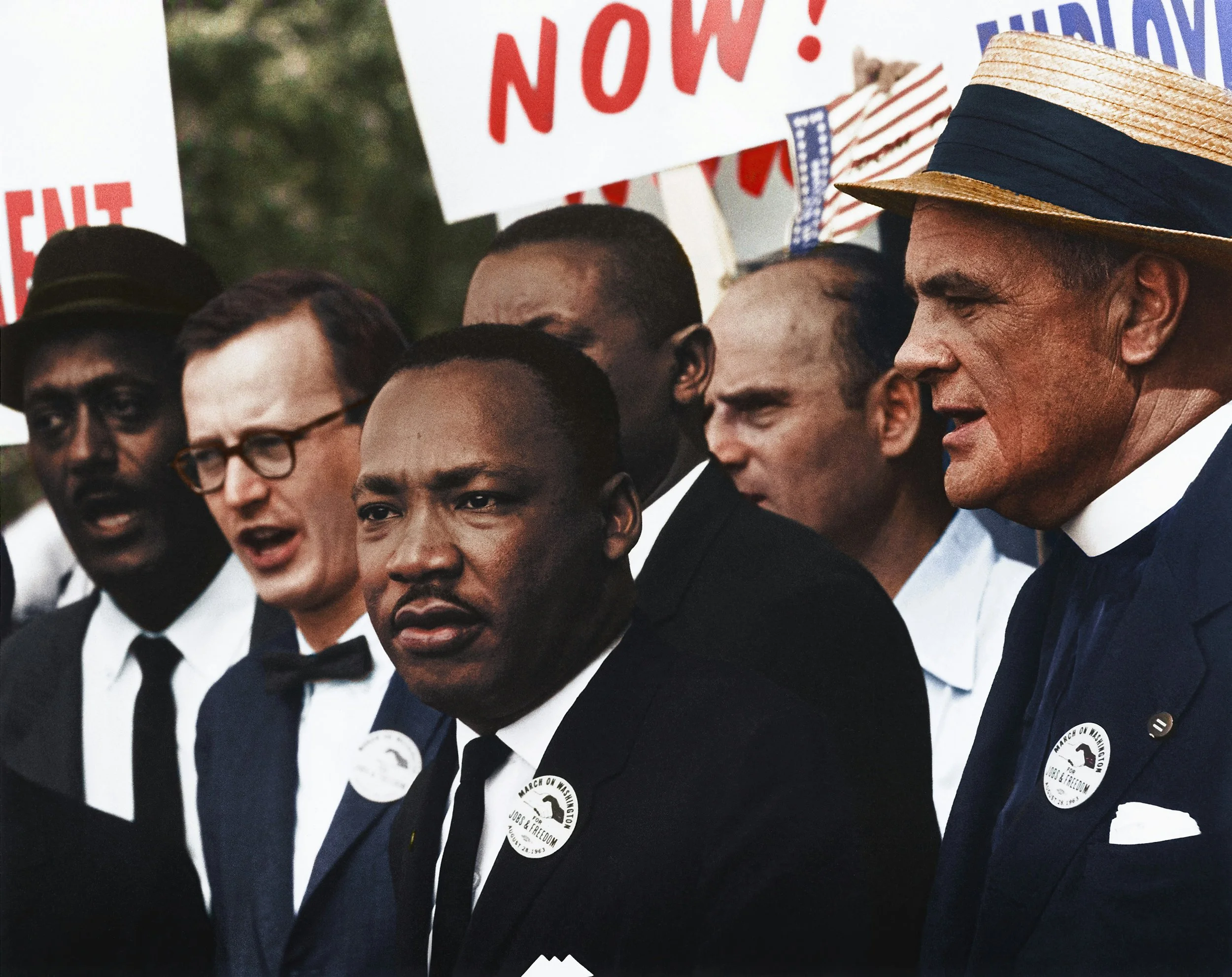
Photograph by Unseen Histories via Unsplash. Original black and white negative by Rowland Scherman. Taken August 28th, 1963 at the March on Washington. Colorized by Jordan J. Lloyd. The National Archives and Records Administration.
Rev. John Zehring
A member of my congregation who was chair of the communications department at a university encouraged me to become an Adjunct Professor of Public Speaking, which I did, teaching a three-hour class once a week in the evening. As I prepared, the first thing I did was to look up great speeches and study them. Top on the list was Martin Luther King, Jr.’s legendary “I have a dream” speech. In addition to my admiration of King as a person and his accomplishments, values, and his great mind, I grew up in a church where my pastor was his classmate at Crozer Theological Seminary in Upland, Pennsylvania, six miles from my home. My pastor took me to visit Crozer and I reverently tiptoed into the classrooms where King studied and prepared himself.
So much of public speaking is attitude. I encourage my students to visualize themselves succeeding. Believe that you can succeed in making your presentation. Believe in yourself. Take inspiration from the Roman poet Virgil: “They can conquer, who believe they can.” Visualize it. When it came to making persuasive speeches, I taught students to help their listeners to visualize benefits to them for the case the student made in his or her speech. Draw word pictures of what their lives might look like if they concur with the position you present. Use vivid imagery to show listeners how they will gain. Paint word pictures. Guide listeners to smell the bacon cooking over the campfire.
In “The 7 Habits of Highly Effective People,” author Stephen Covey extolled the skill of visualizing. Covey wrote about Dr. Charles Garfield, who did “extensive research on peak performers, both in athletics and in business… Although he had a doctorate in mathematics, he decided to go back and get another Ph.D. in the field of psychology and study the characteristics of peak performers. One of the main things his research showed was that almost all of the world-class athletes and other peak performers are visualizers. They see it; they feel it; they experience it before they actually do it. They begin with the end in mind.”
That is what King did. He taught people to visualize… to have a dream… to see it, feel it, experience it. He began with the end in mind. King led the way and set the example to visualize the good, the hope, and the possible. In dismal times, he taught to visualize hope. In dark times, he lifted up the light. In places where human beings sank to their lowest in values, attitudes, and behavior, he encouraged the good, the kind, and the decent. When his generation said “we don’t know what to do or how to respond” to what King labeled the triple evils of poverty, racism and militarism, he gave them six principles to stand for:
Nonviolence is a way of life for courageous people.
Nonviolence seeks to win friendship and understanding.
Nonviolence seeks to defeat injustice, or evil, not people.
Nonviolence holds that unearned, voluntary suffering for a just cause can educate and transform people and societies.
Nonviolence chooses love instead of hate.
Nonviolence believes that the universe is on the side of justice.
Perhaps it is when people are most threatened or oppressed that they crave the hope to visualize a favorable outcome, to dream of what could be rather than what is, and to hold a vision of a better life. Poet Langston Hughes reminds us: “Hold fast to dreams/For if dreams die/Life is a broken-winged bird/That cannot fly.”
Martin Luther King taught us that we must become visualizers and dreamers of a better tomorrow, for if we can’t dream it, we can’t do it.
Like King, Jesus encouraged people to visualize the Kingdom of God. He told them that God’s kingdom was like a pearl of great price. Listeners could visualize a valuable pearl. Jesus taught how “…the kingdom of heaven is like a merchant in search of fine pearls; on finding one pearl of great value, he went and sold all that he had and bought it” (Matthew 13:45-46). We sometimes use the phrase “pearl of great price” in a colloquial way to describe the most valuable thing we have. Your pearl of great price might be a thing, a special person, a skill, a property, or the best piece in a collection. In some cases, much in your life revolves around that pearl. The point of Jesus’ parable is that you doing God’s will is like that. It is worth the journey, the quest, the sacrifice, the price you have to pay, and the leap you make to buy it and own it… and then to be owned by it. That, said Jesus, is what the Kingdom of God is like.
In another simple visualization, Jesus compared a person’s faith to the smallest of seeds, the mustard seed. “If you have faith the size of a mustard seed, you will say to this mountain, ‘Move from here to there,’ and it will move; and nothing will be impossible for you’.” (Matthew 17:20). Listeners could visualize a mustard seed. The mustard seed illustration invites you to trust that your faith is sufficient for God to use to give you the attitude to move mountains and to believe that nothing will be impossible for you. This could be Jesus’ “I have a dream” speech.
In Ephesians, Paul lifts us to a sky-high level of dreaming for a future with hope: “God can do anything, you know – far more than you could ever imagine or guess or request in your wildest dreams!” (Ephesians 3:20 MSG). Therein lies our highest hope, that we are not alone, but that God is our yokefellow in working to bring about a just, fair, and good society.
King’s speech rose out of generations of violence, hopelessness, and darkness. Today, we too witness division, threats, and a nation that seems to lack much in goodness, fairness, or decency. And so, we visualize… we dream for the possible dream that God can do anything, far more than we could ever imagine or guess or request in our wildest dreams. As King taught, we must become visualizers and dreamers of a better tomorrow, for if we can’t dream it, we can’t do it.
Rev. John Zehring worked in higher education for a couple decades and then served United Church of Christ congregations as a pastor in Massachusetts, Rhode Island, and Maine. He is the author of dozens of books. His most recent book from Judson Press is “Get Your Church Ready to Grow: A Guide to Building Attendance and Participation.”
The views expressed are those of the author and not necessarily those of American Baptist Home Mission Societies.
Get early access to the newest stories from Christian Citizen writers, receive contextual stories which support Christian Citizen content from the world’s top publications and join a community sharing the latest in justice, mercy and faith.