
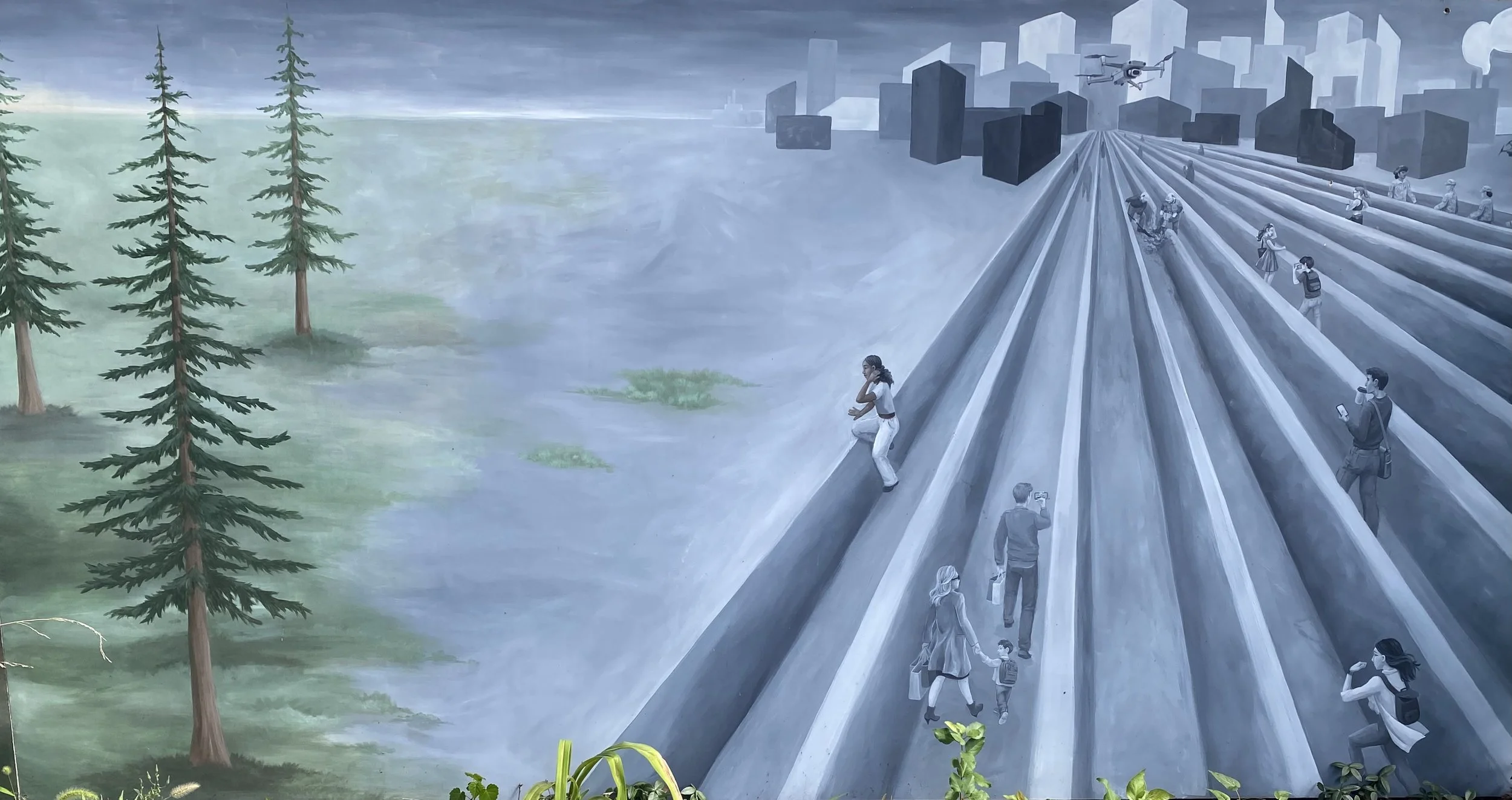
A portion of “The Mad Farmer Mural,” located at the Hiding Place near Washington, DC, inspired by Wendell Berry’s Manifesto: The Mad Farmer Liberation Front and painted by Malea Gascho of Harrisonburg, VA. Photograph by Brian Gorman.
Brian Gorman
Few people in recent history have embodied the prophetic vocation as clearly as Wendell Berry. Known for his gifts with poetry and prose, Berry, who died on August 31, lived a quiet life of consistent resistance to the mechanization of human dignity, the wanton destruction of creation, and the myths of progress that threaten ecological destruction. He fits nearly perfectly Walter Brueggemann’s description of prophets offered in his book, The Prophetic Imagination: “The task of prophetic ministry is to nurture, nourish, and evoke a consciousness and perception alternative to the consciousness and perception of the dominant culture around us.”[i]
In 2012, the National Endowment for the Humanities invited Berry to give the annual Jefferson Lecture in the Humanities. The title of his lecture offers a glimpse into the core ecological and theological principle that animated his prophetic ministry: “It all Turns on Affection.” One paragraph from the lecture succinctly summarizes his view:
For humans to have a responsible relationship to the world, they must imagine their places in it. To have a place, to live and belong in a place, to live from a place without destroying it, we must imagine it. By imagination, we recognize with sympathy the fellow members, human and nonhuman, with whom we share our place. By that local experience we see the need to grant a sort of preemptive sympathy to all the fellow members, the neighbors, with whom we share the world. As imagination enables sympathy, sympathy enables affection. And it is in affection that we find the possibility of a neighborly, kind, and conserving economy.
If we take Berry’s words seriously, there is a direct connection between a clear, prophetic vision for a place truly for what it is (what he calls “imagination"), our affection born from this vision, and our collective ability to create a just society. Berry prods us, gently at times and piercingly so at others, to expand our definition of our “neighbor” to include the trees, animals, and even the soil itself. This multi-species community, our place, is an interconnected web of mutual dependence whose conservation is only possible when motivated by affection and intimacy. We are not separate from our environment; we belong to it as much as it belongs to us. Affection is borne on the coattails of traits like curiosity and wonder. It is adoring love for something as it is, not for what self-serving uses we may derive from it. Properly ordered affection is an ever-expanding circle of concern and welcome that begins with the smallest units of life in the soil and moves out to the plants, animals, and humans. It is a kind of divine hospitality.
Known for his gifts with poetry and prose, Berry, who died on August 31, lived a quiet life of consistent resistance to the mechanization of human dignity, the wanton destruction of creation, and the myths of progress that threaten ecological destruction.
On the other hand, disordered affection for things that are destructive leads to the inverse: injustice, ecological devastation, and an unmerciful, wasteful economy. The “Lords of War,” as he calls the principalities and powers of darkness in his poem “Look Out,” are agents of disordered affection:
Every household of the world is at their mercy,
the households of the farmer and the otter and the owl
are at their mercy. They have no mercy.
Having hate, they can have no mercy.
Their greed is the hatred of mercy.[ii]
One need only glance at recent news headlines to find out whether our world is driven by proper or improper affection. Disordered affection is the thread that connects degradation of soil by commercial farming to the selling of protected wildlife reserves for oil drilling. It is affection for machines over people that is creating a mad race towards artificial intelligence. The “preemptive sympathy” for immigrant and non-American neighbors that ought to flow from our love and protection of the land is choked off by a determined indifference to the destruction of the planet by the Lords of War. What may seem like disparate acts of evil are all rooted in the same affection for destruction and lack of prophetic imagination.
This is why we need the full breadth of Wendell Berry’s prophetic vision to animate our ability to persevere despite what often feels like insurmountable odds, both on a political and a global ecological scale.
Expect the end of the world. Laugh.
Laughter is immeasurable. Be joyful
though you have considered all the facts.[iii]
As our home slides towards a precipice of global climate catastrophe, we must reaffirm our commitment to a loving affection for the places we find ourselves. We will be joyful though we have considered all the facts. We must not let fear prevent us from acting on behalf of our immigrant neighbors: "As soon as the generals and the politicos can predict the motions of your mind, lose it."[iv] And we will not merely watch from the safety of our windows as our neighbors, both human and nonhuman alike, suffer the consequences of the disordered affections of the Lords of War. Instead, we will let Wendell Berry nurture, nourish, and evoke in us a willingness to “say no by saying yes.”
Leave your windows and go out, people of the world,
go into the streets, go into the fields, go into the woods
and along the streams. Go together, go alone.
Say no to the Lords of War which is Money
which is Fire. Say no by saying yes
to the air, to the earth, to the trees,
yes to the grasses, to the rivers, to the birds
and the animals and every living thing, yes
to the small houses, yes to the children. Yes.[v]
Brian Gorman is a piano teacher and gardener at the Hiding Place, a community of hospitality located near Washington, DC.
The views expressed are those of the author and not necessarily those of American Baptist Home Mission Societies.
[i] Brueggemann, Walter. The Prophetic Imagination. 2nd Edition. Minneapolis, MN: Fortress Press, 2001, p. 2.
[ii] Berry, Wendell. "Look Out." Given: Poems. Brooklyn, NY: Counterpoint Press, 2006, pp. 123-124.
[iii] Berry, Wendell. "Manifesto: The Mad Farmer Liberation Front." The Country of Marriage. New York: Harcourt Brace Jovanovich, 1973.
[iv] Berry, "Manifesto."
[v] Berry, "Look Out."
Get early access to the newest stories from Christian Citizen writers, receive contextual stories which support Christian Citizen content from the world’s top publications and join a community sharing the latest in justice, mercy and faith.