
I’m gay AND queer. That matters.
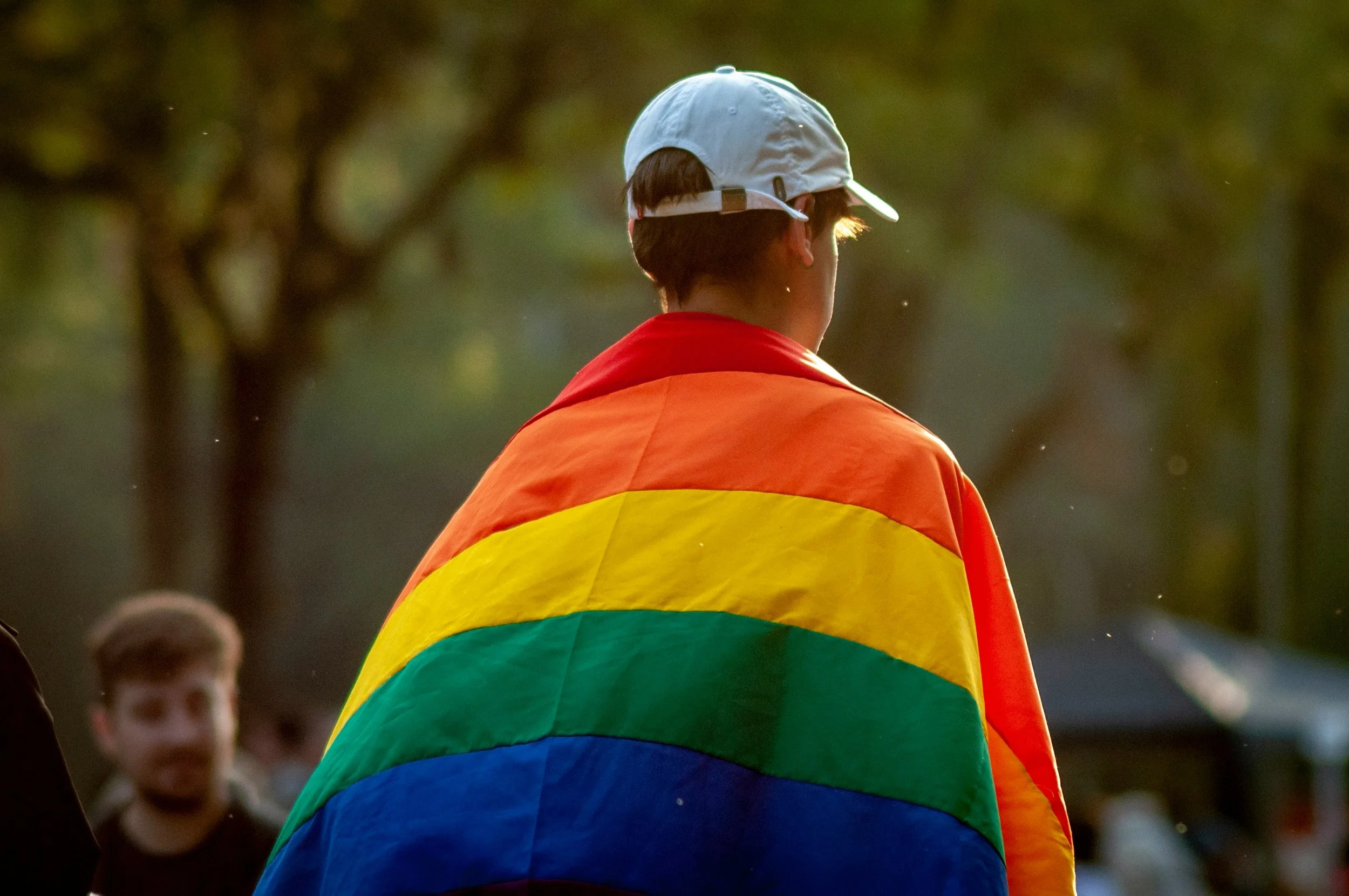
Photograph by Arthur zKrause via Unsplash
Jason Fredlund
I’m gay AND queer. That matters. What began as a response to a recent essay by Matthew Vines quickly became something much deeper: an attempt to tell the story of my own faith. This isn’t about Matthew. It’s about the faith I’ve found on the other side of the Christianity I inherited. I’m still learning, and this is not the final word; simply my best attempt, at this moment, to describe the God I’ve come to know as a queer Christian.
I don’t remember how many times I typed the words “gay” and “Christian” into Google during the early days of the internet. I was a closeted evangelical teenager trying to answer a question that felt like life or death. I wasn’t looking for a political movement or a new identity. I was looking for hope. I wanted someone to tell me that loving Jesus and being gay weren’t mutually exclusive.
There is a story many Christians tell about people like me. That we left the Church. That we abandoned the faith. That we chose culture over Christ. That isn’t my story. I didn’t leave. I was told there was no place for someone like me. I was told, “I love you. We’re praying for you. But you’re not welcome to come back.” For too long I confused those voices with the voice of God. I no longer do.
For years, Google didn’t have much to offer. Then, in my twenties, Matthew Vines emerged. His book, “God and the Gay Christian,” popped up in my internet search and his organization, The Reformation Project, helped thousands of LGBTQ+ Christians, myself included, imagine that reconciliation was possible. Although I never read the full book, I attended The Reformation Project conferences, joined its Leadership Development Cohort, and eventually became friends with Matthew. Which is why reading his recent op-ed in the New York Times distinguishing “gay” from “queer” felt unexpectedly painful. Not because I no longer value the word gay. I still call myself gay because it tells the truth about who I love. I also call myself queer because it tells the truth about the communities that have shaped me and the Gospel that has transformed me.
The timing of this conversation feels significant. America is commemorating its 250th anniversary. Pride Month has just ended. Across the country, debates about identity, freedom, history, and belonging have become increasingly polarized. At the same time, many churches are wrestling with the rise of white Christian nationalism and asking what Christianity should look like in the 21st century.
These are not separate conversations. They’re all asking some version of the same question: Who belongs?For years, my answer was simple. I wanted to belong! That was the gift Matthew offered my generation. He argued that gay people are every bit as human, faithful, and worthy of love as anyone else. That mattered profoundly. It gave many of us permission to imagine a future with both our faith and our integrity intact. I remain grateful for that gift.
Looking back, I realize it wasn’t ultimately Matthew’s scholarship or the conferences that invited me back into a relationship with the Divine. More than anything, it was the people I met and the community I cultivated. Many of the deepest friendships of my adult life began through The Reformation Project (shoutout to my gaggle!) I am eternally grateful to the staff and board of TRP, queer and trans Christians, many of them Black and Brown, whose lives embodied a Gospel larger than I could have imagined. Their courage, joy, and theological imagination reshaped my understanding of God far more than any single book ever could. I realize Matthew answered exactly the question my younger gay self needed: “Can I belong?” The queer Christians that I met through The Reformation Project, Q Christian Fellowship, and beyond have taught me to ask a different question: “Who doesn’t yet belong?”
Over time I began to know myself as queer. Not because my sexuality changed. Because my theology did. To me, queerness is no longer simply an identity. It is a spiritual commitment. A refusal to stop widening the circle of belonging. For me, the social and political meaning of queerness isn’t incidental; it’s the point! Queer names a refusal to leave anyone behind. It calls us to keep asking who is still being marginalized, even within our own communities.
Perhaps that is the question before the Church today: Are we seeking to secure a place for gay Christians within the oppressive structures of Christendom? Or are we willing to follow Christ beyond them, trusting that the gifts, witness, and leadership of queer and trans Christians might help lead the Church into its next reformation?
Working and worshiping alongside transgender people, Black and Brown organizers, folks in recovery, immigrants, disabled leaders, and young people whose identities refuse neat categories, I began to recognize a pattern that had always been present in Scripture. Again and again, God chooses to reveal something about God’s character from the margins. Not because marginalization is holy. But because the margins reveal truths the center often cannot see.
The Jesus I encounter in the Gospels consistently crosses boundaries that respectable religion insists should remain intact. He touched those declared unclean. He praised foreigners. He welcomed eunuchs into God’s unfolding story. He built community among people who had been told they did not belong. The biblical witness does not simply expand the guest list, it expands our collective imagination of who God’s family can become. Some people imagine that being queer required me to leave Christianity behind. The opposite is true. Being queer required me to take Jesus more seriously. The more closely I follow Him, the more I find myself drawn toward those living beyond the boundaries respectable religion had constructed. Queerness has not weakened my discipleship, it’s deepened it.
As America reflects on its first 250 years, many are asking what kind of nation we have become. As a queer Christian, I find myself asking another question. What kind of Church are we becoming? I have come to believe that answering this question requires a distinction our public conversations rarely make. The distinction between Christianity and Christendom. Historians and theologians have long distinguished between Christianity, the movement centered on the life and teachings of Jesus, and Christendom, the centuries-long fusion of Christian faith with imperial, political, and cultural power.
Early Christianity was a movement without political power. For nearly three centuries “Followers of the Way” lived on the margins of empire, proclaiming another Kingdom while refusing to worship Caesar. Beginning in the fourth century, however, Christianity became increasingly fused with imperial power. Over centuries, faith became entangled with conquest, colonization, nationalism, racial hierarchy, and cultural dominance. The teachings of Jesus did not suddenly change. The Church’s relationship to power did.
Across history, Christendom has worn many costumes – imperial Rome, the Crusades, European colonialism, Manifest Destiny, slavery, segregation, and now forms of white Christian nationalism that confuse national identity with the Kingdom of God. The hierarchy changes. The logic rarely does. Yet Christianity has never been reducible to Christendom. At its best, the Christian tradition has continually produced prophets, reformers, saints, and ordinary believers who call the Church back to the way of Jesus whenever it became too comfortable with empire. The deepest impulse of Christianity has never been to preserve Christendom, but to reform it; to expose its idols, challenge its hierarchies, and remind the Church that faithfulness is measured not by proximity to power but by fidelity to Christ. Every generation of Christians must decide whether it will inherit Christendom or allow the Gospel to reform it. Perhaps that is the question before the Church today: Are we seeking to secure a place for gay Christians within the oppressive structures of Christendom? Or are we willing to follow Christ beyond them, trusting that the gifts, witness, and leadership of queer and trans Christians might help lead the Church into its next reformation?
I have come to believe that much of the harm LGBTQ people have experienced did not come from Christ. It came from Christendom.
Christ continued crossing boundaries. Christendom builds them.
Christ welcomed outsiders. Christendom decides who qualifies as insiders.
Christ announced good news to the poor, the imprisoned, the stranger, and those pushed beyond the edges of respectable society. Christendom too often learns to protect respectability itself.
That distinction is changing my life and the way I read Scripture. It’s helped me realize something I wish someone had told me decades ago: It wasn’t Christ who pushed me away. It was Christendom.
I no longer see the Bible primarily as a book of rules and limitations. I see it as an unfolding love story between God and humanity. Rather than maintaining moral boundaries, the biblical story continually disrupts them. Again and again, Jesus crosses lines everyone else insists are permanent. The Samaritan. The tax collector. The woman caught in adultery. The leper. The eunuch welcomed into God’s unfolding story. The foreigner. The sinner. The crucified criminal. These were the stories I first learned in Sunday School, Vacation Bible School, and youth group. The irony isn’t lost on me. Most of what I now cherish about queerness was first taught to me there. Welcome the stranger. Care for the least of these. Share your table. Love your enemies. The first shall be last. Resist the temptations of worldly power. Stand with those pushed to the margins. These values are deeply subversive and countercultural. In that sense, I have come to believe that the Gospel itself is profoundly queer. Not because it fits contemporary categories of identity, but because it continually overturns the hierarchies that empire declares sacred and unsettles every system that privileges power, status, and respectability over love.
I still call myself gay. That tells you something true about who I love. I also call myself queer. That tells you something true about the God I follow. Not because queerness is the center of the Gospel. Christ is. But the Christ I know has always been found among the people the empire pushes to the margins.
That is why “queer” has become such an important word for me. Not because everyone must use it or because it perfectly describes every LGBTQ person. For me, queer names a spiritual commitment as much as a social identity. It reminds me that my liberation is incomplete if it stops with people who look like me, love like me, or are easiest for society to accept. Many of the freedoms I now enjoy as an openly gay Christian man were made possible by people whose lives remained far less “acceptable” than mine – transgender women, queer people of color, activists, organizers, and countless others who refuse respectability because justice demands something deeper. I don’t want to inherit their freedom while forgetting their witness. Their courage makes my life possible, and I won’t abandon their legacy by becoming comfortable too soon.
If anything, I believe queer and trans Christians are already helping lead the Church into who she is called to become. Not because we are morally superior. But because people on the margins often perceive truths that institutions struggle to see. Throughout Scripture, God repeatedly entrusts renewal to those the center overlooks: shepherds instead of kings, prophets instead of priests, women instead of the men in power, Galilean fishermen instead of the religious elite.
For much of my life, I searched for evidence that God could love someone like me. Today my prayer is different. It is for the queer person who left church, or was pushed out, because they believed God had rejected them. If that’s your story, I understand. It was almost mine. May I gently offer another possibility? Maybe it wasn’t Christ who pushed you away. Maybe it was Christendom. Those are not the same thing. One seeks to preserve power. The other surrendered it. One draws lines around who belongs. The other spent a lifetime crossing those lines.
Matthew named his organization The Reformation Project, and I remain grateful for that vision. But perhaps the next chapter of that reformation is not simply convincing the Church that LGBTQ people belong. Perhaps it is allowing queer and trans Christians to help the Church remember who it has always been. The Church’s future will not be secured by asking queer people to become less queer, less trans, less disruptive, or more respectable. I believe its future depends on recovering the radical hospitality, prophetic imagination, chosen family, mutual care, and holy resistance to empire that queer Christians have practiced for generations – often because our survival required it.
The Church I hope my nieces and nephews inherit is not one anxiously guarding its borders or preserving its power. It is one joyfully expanding its table. Not one preoccupied with protecting privilege. A Church that helps make “on earth as it is in Heaven” a lived reality.
I still call myself gay. That tells you something true about who I love. I also call myself queer. That tells you something true about the God I follow. Not because queerness is the center of the Gospel. Christ is. But the Christ I know has always been found among the people the empire pushes to the margins. That is where I first found hope. It is where I continue to find Christ. And I have come to believe it is where the Church will find its future.
Jason Fredlund (he/him) is a Hartford-based facilitator, educator, and writer whose work explores the intersections of identity, faith, and justice. A graduate of both Moody Bible Institute and, a decade later, Hartford International University, he holds an M.A. in Transformative Leadership & Spirituality and a Graduate Certificate in Interfaith Dialogue. He is a white, queer, progressive Christian committed to collective liberation and convinced that honesty, vulnerability, laughter, and human connection can change the world.
The views expressed are those of the author and not necessarily those of American Baptist Home Mission Societies.
Get early access to the newest stories from Christian Citizen writers, receive contextual stories which support Christian Citizen content from the world’s top publications and join a community sharing the latest in justice, mercy and faith.