
Gaza is still hungry
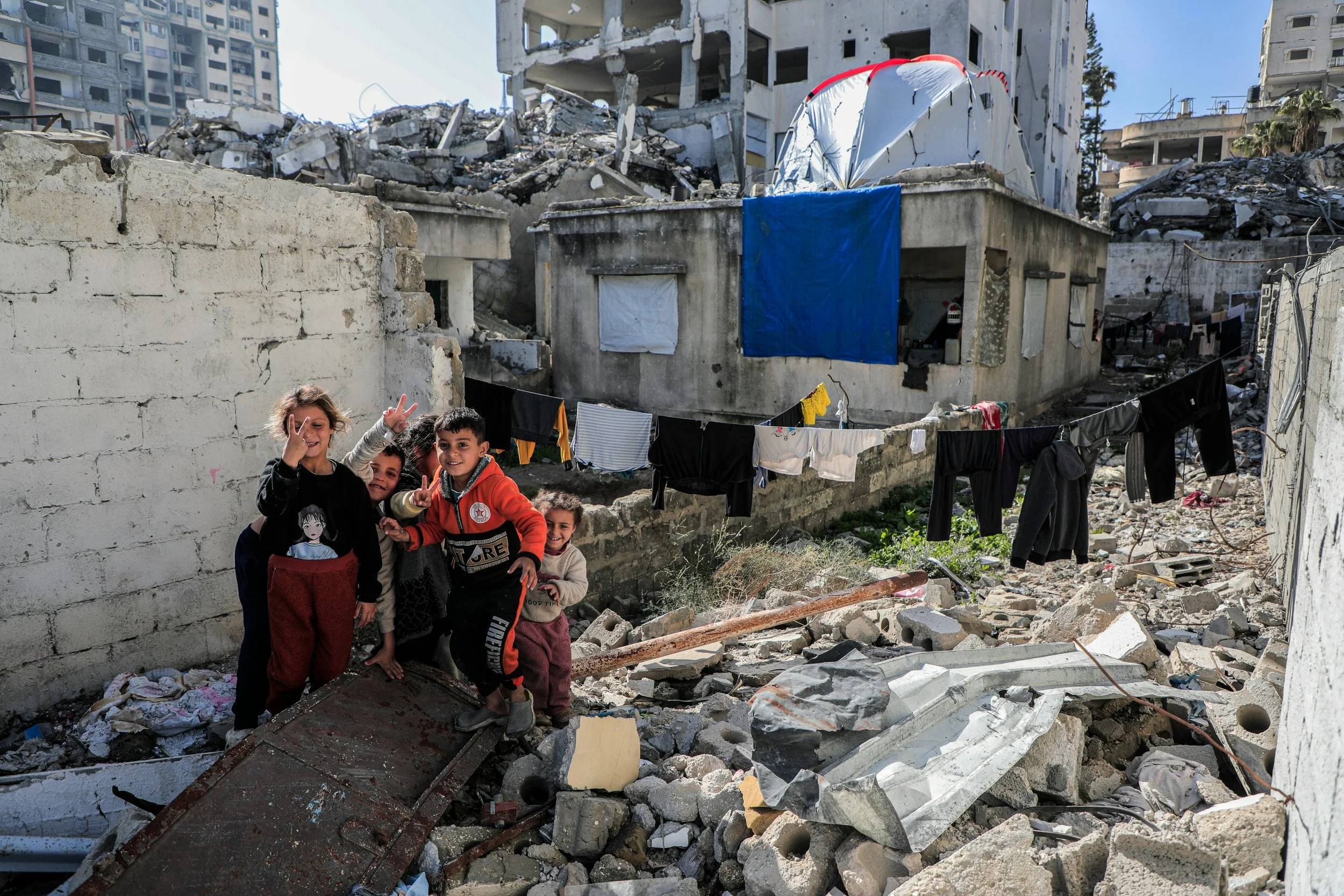
Photograph by Mohammed Ibrahim via Unsplash
Dr. Andrew Wickersham
No one wants to believe that even today civilian populations — including women and children — continue to be starved as part of a calculated military strategy. Even more painful to some American Christians is the thought that the United States, along with our closest ally in the Middle East, might be complicit in such unlawful and immoral acts of war. Such a suggestion could, hypothetically, provoke a crisis of faith for many Christians, especially those who view Israel in a providential light. So when a UNICEF report comes out detailing recent, significant improvements to the nutritional situation in Gaza, it can be tempting to dismiss earlier stories of famine and widespread Palestinian starvation as the exaggerations of “rabidly anti-Israel” NGOs. However, if we are to heed Jesus’s calling to be peacemakers, our response to this crisis must be twofold: call on our diplomats to negotiate an immediate end to Israel’s blockade of Gaza and implore our members of Congress to limit — or even end — arms shipments to Israel.
This response is certainly not how most politicians reacted to the news. Despite the “complex nutritional picture” the UNICEF report paints, both U.S. and Israeli governments jumped on it as proof that children in Gaza are not starving and that the UN’s August 2025 famine designation was rooted in anti-Israel prejudice. However, as a research fellow at Churches for Middle East Peace (CMEP) following the situation in Gaza since 2017, I noted two truths in this report. First, since the resumption of humanitarian aid following the October 2025 ceasefire, acute malnutrition in the Gaza Strip has dramatically decreased. Second, there is still an ongoing nutritional crisis in Gaza, and if this aid were to be cut, conditions would likely reach famine levels again.
The UNICEF Smart Survey at the heart of this controversy assessed nutrition among children ages 0-5 years old and maternal health among girls and women ages 15-49 between May and June 2026 in the Gaza Strip. Its findings offer a glimmer of good news for anyone concerned about the wellbeing of Palestinians: acute malnutrition — the life-threatening condition caused by a sudden lack of nutritious food — has declined by over 80% among Gaza’s children since the ceasefire began. At the same time, however, the humanitarian situation remains dire. “[R]ates of chronic malnutrition (stunting), maternal malnutrition, very poor dietary quality, suboptimal infant and young child feeding practices, and a substantial burden of childhood illness” remain stubbornly high. In other words, thanks to the resumption of outside aid, children’s minimal daily caloric needs are being met again, but the long-term health effects of having been deprived of food for two years persist.
Despite this recent improvement, nothing in my experience suggests that NGOs were exaggerating the severity of starvation in Gaza last year. I was sadly not at all surprised by the UN’s famine designation in August 2025. When I first started working for CMEP, Gaza was still recovering from the 2014 war with Israel. At that time, the average Gazan could only count on electricity for three hours a day. Without sufficient power, the Strip’s drinking water had become dangerously contaminated as its sewage treatment plants ceased to work consistently. Hospitals could barely provide adequate treatment under these conditions. Almost a decade ago, the UN predicted that Gaza would be totally unfit for human habitation by 2020. With the outbreak of war in 2023, we realized that the nightmarish conditions in Gaza were only about to get worse. UNICEF’s report chillingly hints at the pervasiveness of hunger and deprivation in Gaza prior to the ceasefire.
If we are to heed Jesus’s calling to be peacemakers, our response to this crisis must be twofold: call on our diplomats to negotiate an immediate end to Israel’s blockade of Gaza and implore our members of Congress to limit — or even end — arms shipments to Israel.
The mountains of statistical data obtained from this report paint a clear picture that humanitarian aid has somewhat alleviated what were once famine conditions. Today, the percentage of children suffering from acute malnutrition has fallen to 0.5%. However, even with aid shipments becoming more regular, only 30.3% of children in Gaza are able to obtain minimum dietary diversity and only 22.4% of these can reasonably be said to have a “minimum acceptable diet.” To put that in less technical language, 73% of children in Gaza rely on unhealthy food to meet their caloric needs and more than half lack access to fruits or vegetables. As a result, more than 12 percent of children under the age of five still suffer from chronic malnutrition, leading to stunted growth. As the report notes, chronic malnutrition “can cause life-long and irreversible cognitive and development impairments.” If this is the nutritional picture today, what must Gaza have been like prior to the resumption of food shipments from the outside world?
This grim picture has not only been ignored but deliberately distorted in an attempt to exonerate Israel. Israel’s Ambassador to the United Nations immediately seized on the report as proof that “Israel is not starving children.” Media Line announced “UN Nutrition Study Challenges Gaza Famine Narrative.” And the Jewish Chronicle reported that this study “completely shatters the narrative promoted by advocacy organisations…that [Gaza’s] population is being deliberately starved.” This spin is extremely misleading. The UNICEF report is a nutrition survey; it is not an Integrated Food Security Phase Classification (IPC) system analysis, which the UN uses to define famine. Even with the IPC downgrading its April-June 2026 Gaza assessment to a Level 3 Crisis, in which households have “food consumption gaps that are reflected by high or above usual acute malnutrition,” neither report contradicts the August 2025 finding that Gaza was experiencing a human-made famine.
The recent UNICEF report in no way absolves Israel’s government of creating famine conditions in Gaza; instead, it highlights the importance of continued humanitarian assistance. CMEP has consistently advocated the unfettered shipment of food and medical supplies into Gaza. Back in 2017, we raised money to send 570 solar-powered lights to Gazan families to offset electricity cuts. While a major undertaking, given our resources, we recognized that our Lights for Gaza Campaign only scratched the surface of Gaza’s urgent needs. Today, that need is even more acute. Should the conflict escalate (which is a very real possibility still), Israel would undoubtedly again double down on its already draconian blockade. It is therefore vital for Christians to insist that our elected officials use their considerable leverage to pressure Israel to lift its blockade. Congress could make this a condition for any new arms shipments to Israel, or better yet, suspend military aid until all human rights abuses in the occupied Palestinian territories have been addressed as current U.S. law requires.
For some American Christians, it can be challenging to sympathize with the people of Gaza, even after reading about the scale of their suffering, due to common prejudiced narratives that depict all Palestinians as complicit in the terrorist attacks of October 7. In contrast to such prejudice, the region’s tiny community of fewer than 1,000 Christians offers a striking counterexample of Christian love. The Al Ahli Arab Hospital in Gaza City is a ministry of the Episcopal Diocese of Jerusalem. It is currently the only operational hospital in Gaza, serving both Muslims and Christians alike. Despite being struck by missiles multiple times since October 2023, the medical professionals at Al Ahli continue to treat Gaza’s wounded. If Palestinian Christians can extend such grace to help their Muslim neighbors no matter their politics, American Christians should not feel any hesitation to give an equally impassioned defense of the inherent dignity of each and every person in Gaza as humans created in God’s image.
Dr. Andrew Wickersham is an Ambassador Warren Clark Fellow with Churches for Middle East Peace, a coalition which works to encourage US policies that actively promote a comprehensive resolution to conflicts in the Middle East with a focus on the Israeli-Palestinian Conflict. He recently completed his PhD in history at the University of Arizona and holds an MA in Middle East studies from the University of Chicago. He is the co-author, along with Rev. Dr. Mae Elise Cannon, of “A Faithful Remnant: The 2000-Year Story of Christianity in the Middle East,” which explores the history, beliefs, culture, and current events surrounding the Christian communities of the Middle East.
The views expressed are those of the author and not necessarily those of American Baptist Home Mission Societies.
Get early access to the newest stories from Christian Citizen writers, receive contextual stories which support Christian Citizen content from the world’s top publications and join a community sharing the latest in justice, mercy and faith.