
Finding light in the dark this Hanukkah
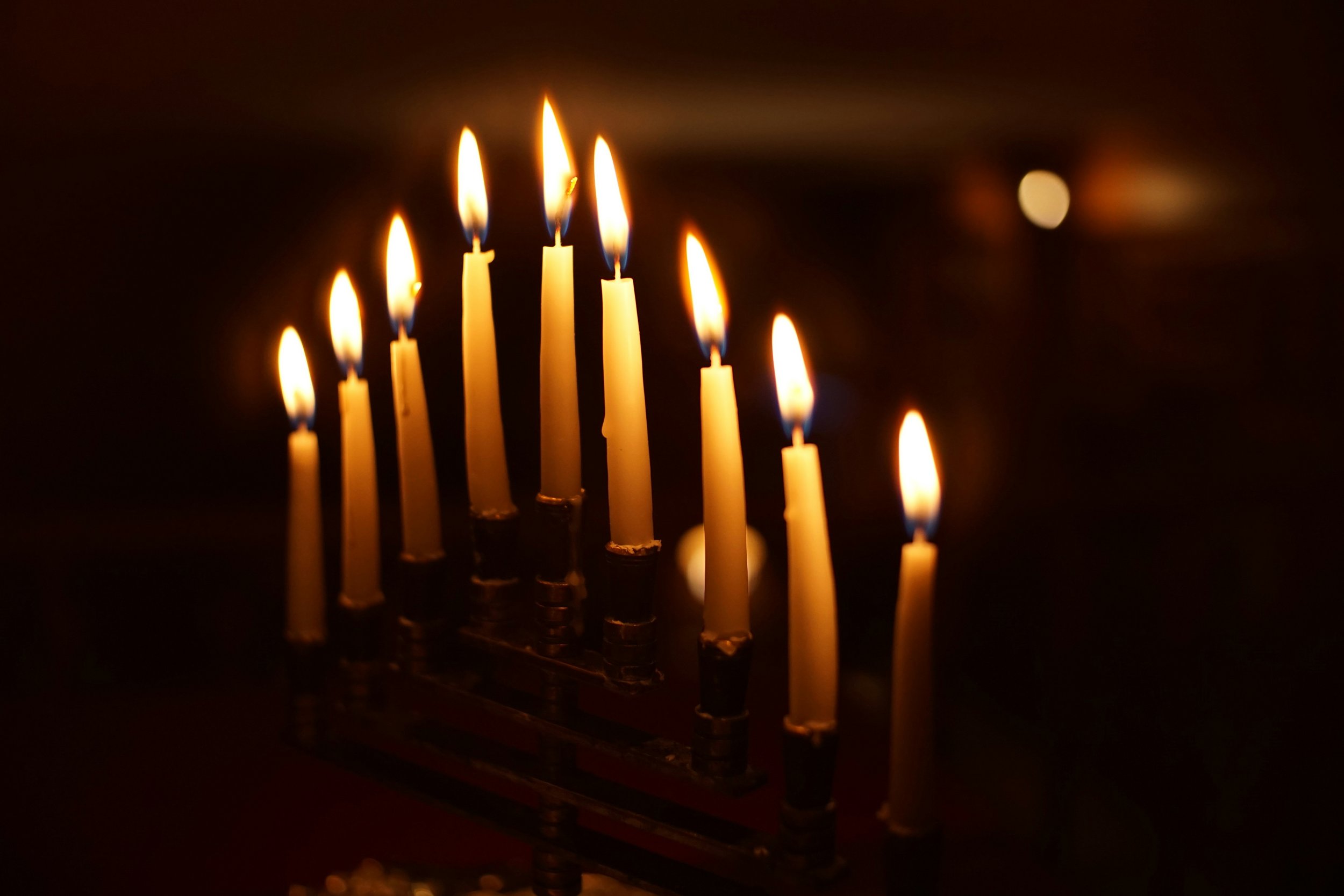
Photograph by Gary Sankary via Unsplash
Jonah Mac Gelfand
We live in a dark and scary time. And reading the daily news only brings with it a sense that the darkness is encroaching ever closer — perhaps it already feels like it is upon you. This feeling is heightened this time of year as the natural world seems to mirror this inner experience, with the winter months heralding the dreaded early dusk.
And it is at this calendrical moment — when everything seems overtaken by the growing darkness of the human world and its mirror in our natural surroundings — that the Jewish holiday of Hanukkah falls.
Over the years, this winter holiday has taken on many meanings. Historically, the holiday commemorates the rededication of the Jerusalem Temple after its desecration by the Greeks in 164 BCE. Overlaid upon this is the celebration of two overlapping miracles: first, the underdog Maccabee soldiers' defeat of the much stronger Greek army who had ransacked the temple; and second, the oil that should have only lasted for one night lasting for eight nights. To celebrate these feats, Jews gather for an eight-night festival each winter to light eight-branched candelabras (called a menorah), eat oily fried food, and play with spinning tops, called dreidels. The holiday is one of joy and celebration, with much singing and dancing over our ancestors’ deliverance.
But there is another, more subtle message of this holiday: the evergreen spiritual practice of uncovering light amidst darkness.
In fact, in the first century, there was a famous argument between two schools of early rabbis about the order of lighting the menorah. The School of Shammai believed you should start with eight candles and light one less each day, so that on the last day you only light one. Their reasoning was that the candles correspond to the “incoming days” of the holiday — i.e., the first day has eight days left, the second day has seven days left, etc.
The School of Hillel, on the other hand, believed that you should start with one candle on the first night, and increase the number of candles by one each day so that by the last night, you light eight. Their reason was because of the general principle that “one elevates in matters of holiness, and does not downgrade.” This is to say, it is unbecoming to shift something to a less holy matter. (The example given elsewhere is the prohibition of downgrading from a gold to silver instrument in the temple worship.) And it is Hillel’s practice of increasing the light that comes down to us in the Legal Codes as the normative practice today.
Amidst the darkness of winter — which, as we’ve seen, is perhaps reflective of our inner lives — our rabbis prescribed this ritual to illustrate that once you uncover a single spark of light in the shadows, it is only natural that more will come to follow.
May this winter season bring with it the revelation of the manifold miracles that light up our lives amidst the shadows.
This idea was picked up on by the 18th-century Polish mystic Rabbi Avraham Yehoshua Heschel of Apt (who was the grandfather and namesake of the well-known 20th-century Abraham Joshua Heschel) in his exploration of Hanukkah. He teaches that once the Maccabees lit the oil on the first day — which thereby catalyzed the oil to burn for the full eight days — the entirety of that miracle was in motion. This is to say that in retrospect (or perhaps, from Heaven’s perspective), the miracle was revealed on the first day. And yet, in the lived experience of the people gathered at the time, that was not the case.
I can almost picture them, huddled around the meekly burning flame, certain it would go out at any moment. For them, the miracle continuously unfolded each moment before their eyes! The full grandeur of the miracle was concealed “until they saw, day by day, how the miracle grew greater and greater.” Each day brought with it more miracles — but only because they were willing to take the leap and light the oil on that first day.
Perhaps this type of faithful curiosity — exemplified by the lighting of the oil even though it wasn’t enough for their needs — is the kind of posture that we are being asked to take on through the practice of lighting Hanukkah candles.
And to take it a step further, the Ukrainian mystic Rabbi Levi Yitzhak of Berditchev (who lived a generation before Heschel) taught that unlike the biblical miracles at the Red Sea which transcended nature, the miracles of Hanukkah occurred within the laws of nature. Instead of the sea splitting, the Israelites prevailed over the superior Greek army. In fact, the Divine is not mentioned in the story at all.
Levi Yitzhak uplifts this narrative as closer to our lived reality than the Exodus. We do not experience earth-shattering miracles in our day. Instead, we must keep our eyes peeled and seek out the little spark of the divine in each of our encounters. Levi Yitzhak asserts that the practice of lighting candles each Hanukkah season is meant as a reminder of the fact that miracles do in fact happen within the natural world — the very world we live in! — if only we do the work to help them be revealed.
I started this piece by saying that we live in a dark time. And this is true. But it is imperative, the rabbis are telling us, that we hold a posture of openness: that we not only seek out the miraculous little spark of light, but that we are open to the possibility that the full magnitude of those miracles is yet to be revealed.
May this winter season bring with it the revelation of the manifold miracles that light up our lives amidst the shadows.
Jonah Mac Gelfand (he/him) is a rabbinical student at Hebrew College in Boston. He is the co-founder and editor-in-chief of Gashmius Magazine, which publishes progressive neo-Hasidic art, poetry, and writing. Before starting rabbinical school, he got his MA in Jewish Studies from the Graduate Theological Union, where his research focused on neo-Hasidic leadership, and his writing has been published in both popular and academic journals.
The views expressed are those of the author and not necessarily those of American Baptist Home Mission Societies.
Get early access to the newest stories from Christian Citizen writers, receive contextual stories which support Christian Citizen content from the world’s top publications and join a community sharing the latest in justice, mercy and faith.