
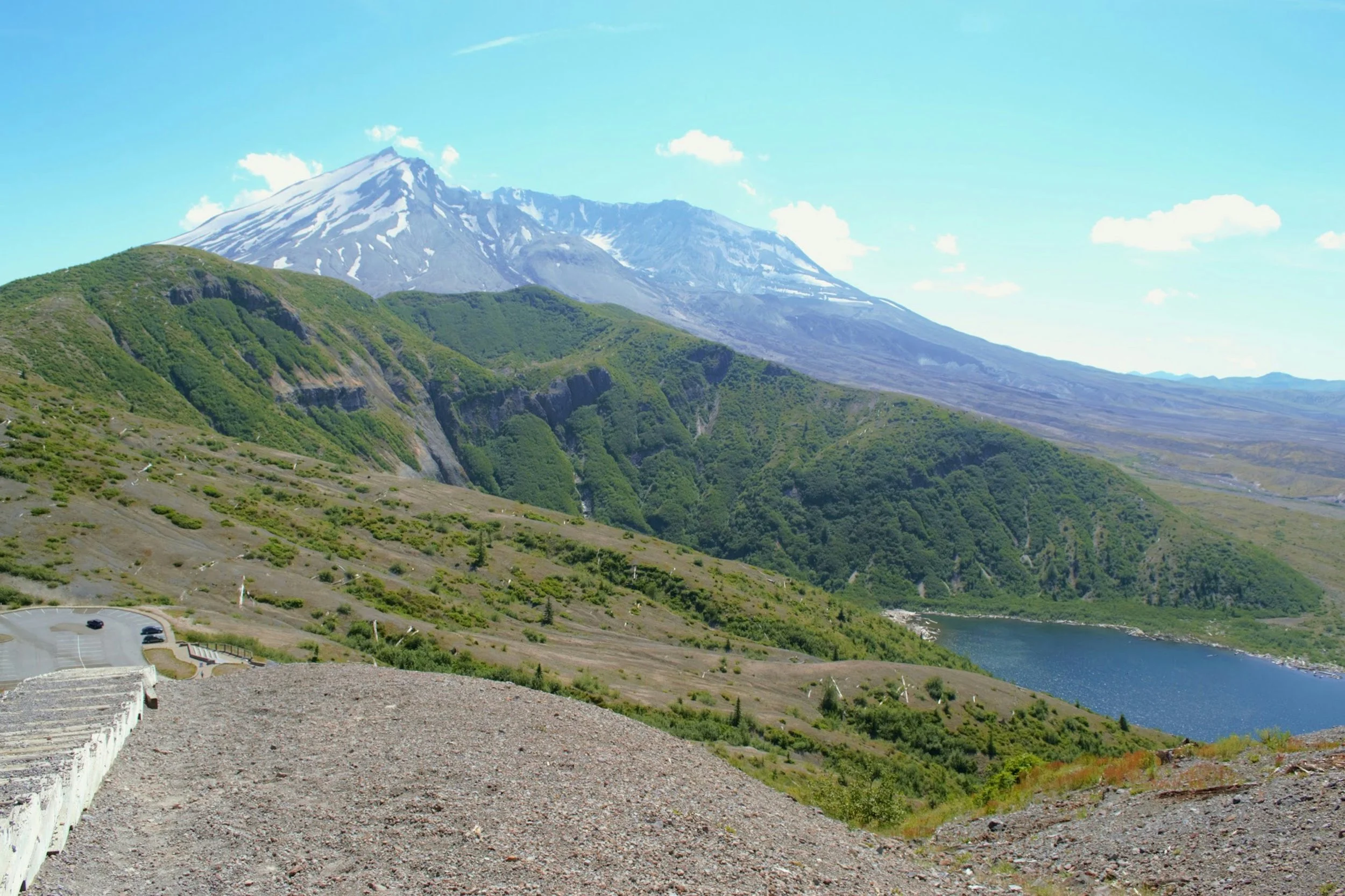
Mt. St. Helens and Spirit Lake. Photograph by Debra Manny Mosley via Unsplash.
Rev. Margaret Marcuson
We didn’t even mention Ash Wednesday when I was growing up. That was for Catholics. Yet as an adult, I have found it one of the most meaningful services of the year.
I live in Portland, Oregon, which knows something about ashes. On May 18, 1980, Mt. St. Helens in Washington state erupted. The eruption was heard in Vancouver, British Columbia, 300 miles away. Day turned to night as the ash traveled. It’s still an active volcano. Some years ago, it spurted ash again. Ashes fell on our sidewalk from 90 miles away.
With Mt. St. Helens in mind, I read the Ash Wednesday text from the book of Joel. The prophet describes the coming of the “day of the Lord” – “a day of darkness and gloom, a day of clouds and thick darkness! Like blackness spread upon the mountains a great and powerful army comes” (Joel 2:1-2). Joel uses the image of the clouds of a locust plague for the armies of God’s judgment. But these images of clouds and darkness also remind me of the destruction that occurred on that day in 1980.
And the prophet’s words remind me of the darkness of these days. We taste the very ashes of life in our mouth. We see dark forces at work in our nation and in our world. We may stand before the ruination of our dreams, sometimes by others, sometimes by our own hand. Our best intentions and hopes have come to nothing.
But as we view the charred remains of our hopes, God’s word comes to us, “Now is the day of salvation” (2 Corinthians 6:2). While we have life, God gives us potential to grow, to recover from disaster, to hope.
After Mount St. Helens erupted, volcanic ash was everywhere. Spirit Lake, the largest lake near the volcano, was covered with tons of ash, logs, and debris.
God can bring new life – something creative – even out of the ashes of our worst nightmares.
Just weeks after the eruption, Forest Service scientists Jerry Franklin, Frederick Swanson, and James Sedell touched down by helicopter at Ryan Lake near Mt. St. Helens. Franklin stepped out of their helicopter. He glanced down, and to his surprise, he saw a green shoot. It was just two or three inches tall. It was the common fireweed. Looking around he saw more, along with other signs of life. Elsewhere that day they saw a white trillium. All had not been destroyed. Over time, the recovery of life continued.
We underestimate our God-given potential for recovery and renewal. Just when we think we are at the end of our rope, we find new resources to continue. The Easter story tells us that God is in the business of bringing new life out of death, hope out of hopelessness. That’s the way God works.
God can bring new life – something creative – even out of the ashes of our worst nightmares. It is not our “trying harder” that makes the difference, but God’s gracious action in our lives and our world. We have work to do, but God brings the renewal.
Even when we feel at the mercy of external forces, we can find new life. God offers life and hope. Rather than sinking into despair, we can find a new sense of call to the world as it is. We keep carrying out that call, moment by moment.
The very ashes of our lives and of our world can enrich the soil so the seeds of hope can grow. God can bring life even when there seems to be none. Let us claim this hope!
Rev. Margaret Marcuson is an American Baptist minister and author of several books: “Leaders Who Last,” “Money and Your Ministry,” and “Sustainable Ministry”(forthcoming).
The views expressed are those of the author and not necessarily those of American Baptist Home Mission Societies.
Get early access to the newest stories from Christian Citizen writers, receive contextual stories which support Christian Citizen content from the world’s top publications and join a community sharing the latest in justice, mercy and faith.